
CDN push vs pull: why Netflix doesn't buffer in Kathmandu
CDN push vs pull, in depth: Nginx cache internals, hit ratio math, shields, coalescing. Modeled startup: origin 318 ms, cold pull edge 335 ms, pushed edge 75 ms.
 Video · 60 secondsWatch the short versionSame diagrams and numbers. Tap to play.
In this lesson you will learn
- How a pull CDN fills its cache on a miss and why the first viewer of new content still pays the origin trip
- How a push CDN places content ahead of time, and when a hybrid of pushing the popular head and pulling the long tail pays off
- How Nginx actually stores, loads and evicts cached objects, and how to size an edge cache with worked numbers
- How HTTP caching rules (Cache-Control, Age, s-maxage) and hit ratio decide the latency and origin load you get
Builds on Lesson 13: DNS: from a name to an address 21 min read + 60 s video Next: Load balancer vs reverse proxy

Drafted with AI assistance, then checked and edited by a human engineer · How we write
Every byte a viewer receives has to travel from wherever it is stored, so a video kept only in one faraway data center pays a long round trip on every chunk, and a player with a small buffer stalls. A content delivery network moves copies close to viewers, but CDN push vs pull, whether copies are pulled on demand or pushed ahead of time, decides whether the very first viewer of new content still waits. The question to be able to answer: why does a streaming service copy video near you before you press play?
Prerequisites
Round trip time and why distance wins. A round trip (RTT) is the time for a small request to reach a server and the reply to come back. Light in fiber covers roughly 200 km per millisecond, and real routes are longer than straight lines, so a server on another continent costs hundreds of milliseconds per round trip no matter how fast it is. In the previous part on DNS we saw that a lookup is a sum of round trips; fetching content is the same: every request that must cross an ocean pays the ocean.
Latency is not bandwidth. A fat pipe moves many bytes per second but does not make the first byte arrive sooner. A player needs bandwidth for picture quality and latency for start time; the article on latency and throughput covers the difference. This one is mostly about latency.
Caching. A cache keeps a copy of something close to whoever needs it, with a rule for when the copy is too old. Read replicas in one database writes, ten read are caches of a database; DNS resolvers cache names; a CDN caches files and video.
Definitions
Origin server: the server (or storage bucket) that holds the authoritative copy of the content. Every other copy is derived from it.
Edge server: a cache server placed close to viewers, often inside or next to an internet provider's network, that answers requests from its local copy when it has one.
CDN (content delivery network): a network of edge servers in many locations plus the routing that sends each viewer to a nearby one. Its two jobs are lower latency for viewers and lower load on the origin.
Cache hit and cache miss: a hit is a request the edge answers from its own copy; a miss is a request for something the edge does not have (or has only in a stale form), so it must fetch from upstream first.
Pull CDN: the edge fetches an object from the origin on the first request that misses, stores it, and serves later requests from that copy. The origin does nothing special; the edge pulls.
Push CDN (proactive caching, cache warming): content is copied to edge storage before anyone requests it, by an upload or by a fill job the operator schedules.
Cache hit ratio: hits divided by all requests. A byte hit ratio does the same with bytes, which matters for video because objects are large.
TTFB (time to first byte): time from sending a request to receiving the first byte of the response. It includes the network round trip and the server's work, but not the time to download the rest of the body.
Segment (chunk): a short piece of a video, usually a few seconds long, served as an ordinary HTTP object. HLS and MPEG-DASH both cut video this way and list the segments in a playlist or manifest, which is why plain HTTP caches can serve video.
How it works: a request through an edge
A player does not download one huge file. It fetches a manifest (an HLS playlist, defined in RFC 8216, or a DASH MPD) that lists the segments, then fetches segment 1, segment 2 and so on, each as a separate HTTP GET. Each segment is just a URL with bytes behind it, so any HTTP cache can store it; that is what makes CDNs work for video.
Here is a single segment request through a pull edge:
- Routing. DNS or anycast steers the player to a nearby edge; behind that edge, a load balancer or reverse proxy often spreads requests over several cache servers.
- Cache key. The edge builds a key from the request, usually the host and path, sometimes selected headers or query parameters.
- Lookup. If the key is in the cache and the copy is fresh, it is a hit: the edge streams the bytes back. Cost: one short round trip plus a little server time.
- Miss. If the key is absent, the edge opens (or reuses) a connection to the origin, asks for the object, and waits for the first byte to cross the long path.
- Fill. As the bytes arrive the edge writes them to its cache (memory or disk) and forwards them to the player. Writing, indexing and possibly evicting another object take time; our lab calls this the miss overhead.
- Reuse. The next viewer who asks for the same key gets a hit.
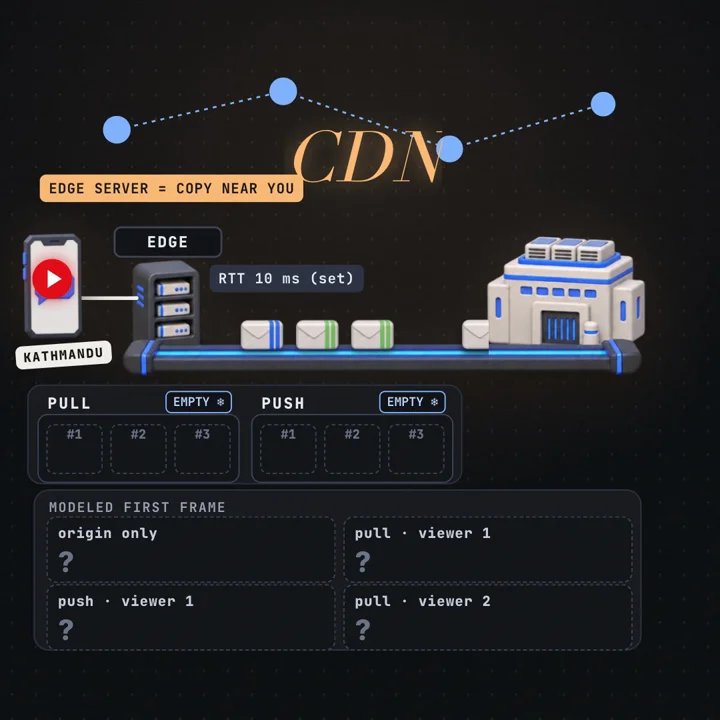
Notice what a miss costs. It is not just "the file is far away". The viewer pays the short hop to the edge, then the edge pays the long hop to the origin, plus the origin's own server time, plus the edge's lookup and store work. So for that one request, a pull edge can be slightly slower than going straight to the origin. The benefit only appears on the second request for the same object.
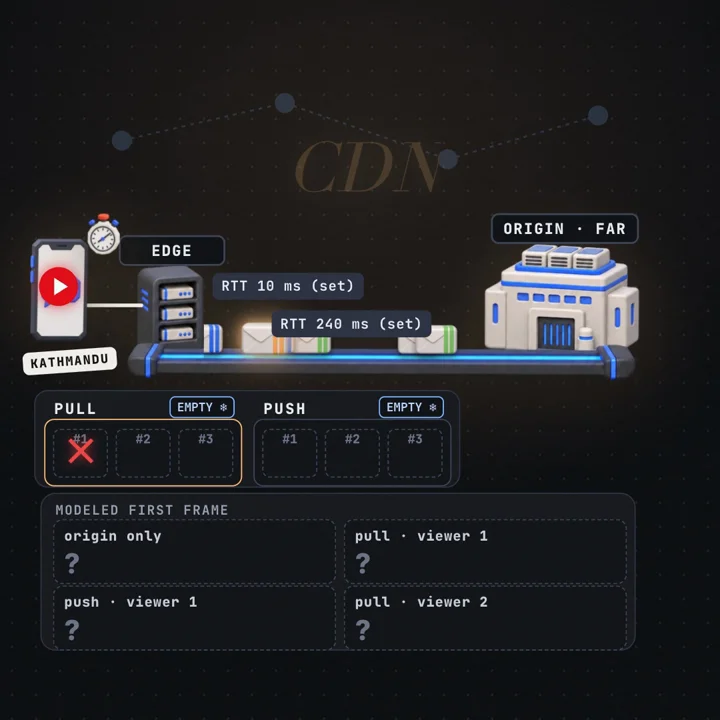
What the player does with those times
A player keeps a buffer of downloaded but unplayed media. A stall (rebuffering) happens when that buffer drains to zero. In general the buffer level B changes as
dB/dt = (delivery rate / media bitrate) − 1      (seconds of media gained per second, while playing)
stall when B reaches 0
So stalls depend on how many seconds of media are buffered and on the sustained delivery rate relative to the bitrate, not on one request's latency. Our lab uses a deliberately simplified version: the player asks for each segment a fixed lead time before it is due, and
lab rule: stall if TTFB + transfer time > lead time (300 ms)That makes per-request latency visible, which is the point of the model. Real players keep many seconds of buffer, so steady playback rarely stalls on a few hundred milliseconds of TTFB.
Startup is where latency shows most, but it has more parts than one segment fetch: manifest fetch, DRM licence if any, initialization segment, then media, transfer and decoder start. Our lab reports modeled startup time, assuming playback waits for the complete first segment: TTFB of segment 1 plus its transfer. A player using progressive delivery (for example low-latency modes that decode partial segments or CMAF chunks) can start before the whole segment arrives, so treat the lab number as a model of one component, not a measured start time.
CDN push vs pull: who triggers the fill?
The difference is who triggers the copy.
In a pull design the viewer's request triggers it. Nothing is stored until someone asks, so the cache holds what people actually watch, with no planning. The price is the cold miss: the first viewer of each object at each edge pays the long trip, and if many press play on a new episode at once, the origin sees a burst.
In a push design the operator triggers it. A fill job copies chosen content to the edges before it is requested, ideally when links are idle, so the first viewer is as fast as the hundredth. The price is storage and prediction: every byte pushed that nobody watches wastes disk and transfer.
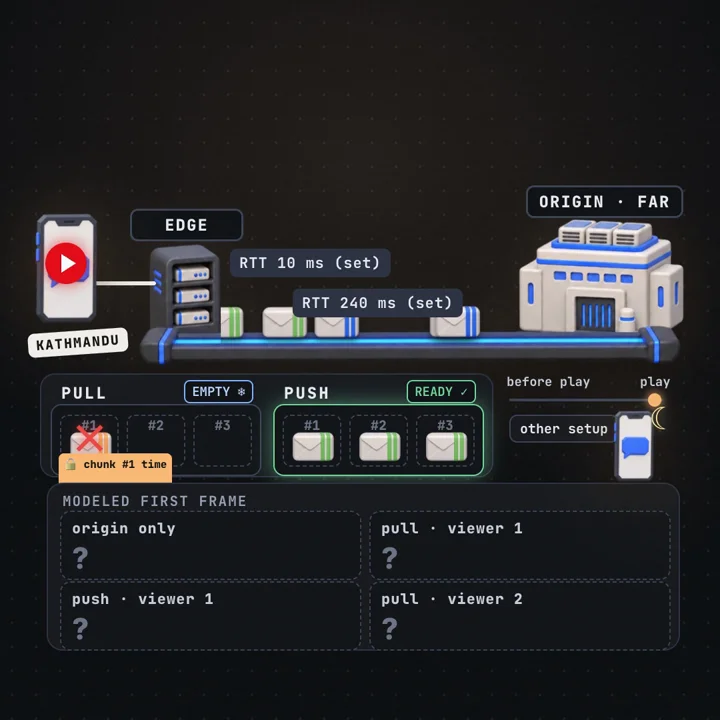
Netflix publishes one relevant fact about its own CDN. Its Open Connect overview says content is placed on Open Connect appliances ahead of time (proactive caching), mostly during off-peak hours. That is push, timed for when the network is quiet. We do not describe any other internal detail of their system; everything else in this article is a typical design.
A hybrid is one option when popularity is skewed, with a small head of titles or files taking a large share of requests and a long tail getting a few each:
- Push the head. Content that is predictably popular (a new release, a launch page, a game patch) is pre-positioned at edges during a fill window.
- Pull the tail. Everything else is fetched on demand and kept while it is used, evicted when space is needed (Nginx, for example, removes least recently used data when the cache exceeds
max_size). - Prefetch within a title. A pull edge can fetch segment N+1 when segment N is requested. That only turns the next request into a hit if the edge guesses the rendition (bitrate) the player will actually pick, the prefetch completes before the player asks, there is spare origin and link capacity for it, and the object is still resident when requested. With adaptive bitrate, a wrong rendition guess is pure wasted fill.
The real question is the cheapest way to make the first request at each edge a hit for content that matters.
When does pushing pay? A break-even example
Model the requests for one object at one edge as a Poisson process with rate λ, and let T be the residency window (how long a pulled copy would stay before eviction or expiry). Assume one fill per window, and the same object size S for push and pull. Then:
P(pull fetches the object in a window) = 1 − exp(−λT)
expected pull bytes per edge per window = S × (1 − exp(−λT))
push bytes per edge per window          = S                    (pushed whether or not anyone asks)
push / pull byte ratio                  = 1 ÷ (1 − exp(−λT))
Worked numbers:
λT = 0.1  → 1 − e^−0.1 = 0.0952   → 9.52% of edges ever request it   → push moves ≈ 10.5× the pull bytes
λT = 1    → 1 − e^−1   = 0.632    → push moves ≈ 1.58×
λT = 3    → 1 − e^−3   = 0.950    → push moves ≈ 1.05×
So for a title expected to get about three requests per edge per window, pushing costs almost nothing extra in fill bytes and removes the cold miss for the first viewer at every edge. For a tail title at λT = 0.1, pushing to every edge spends about 10.5 times the transfer and storage of pulling, to save one miss penalty (in our model, 335 ms against 75 ms of modeled startup) for the roughly 9.5% of edges that see a viewer at all. Weigh the extra bytes, priced in off-peak transit and edge disk, against the value of that first-request latency. The model ignores popularity changes inside the window, partial fills and push-time failures; it is a placement heuristic, not a forecast.
How do HTTP caching rules control a CDN?
A pull edge is an HTTP shared cache, and the rules for shared caches are in RFC 9111. The origin controls the edge mostly through response headers.
Freshness. A stored response is fresh while its age is below its freshness lifetime. The lifetime comes from Cache-Control: s-maxage (for shared caches only), else max-age, else the Expires header, else a heuristic. In formula form:
fresh  if  current_age < freshness_lifetime
freshness_lifetime = s-maxage, else max-age, else (Expires - Date), else heuristic
Age. When a cache serves a stored response it sends an Age header: its estimate, in whole seconds, of the time since the response was generated or last validated at the origin. Per RFC 9111 section 4.2.3 it is computed from the upstream Age value, the apparent age (max(0, response_time − date_value)), a correction for request transit delay (response_delay), and the time the copy has sat locally:
corrected_initial_age = max(apparent_age, age_value + response_delay)
current_age           = corrected_initial_age + resident_time
Age: 0 therefore does not prove a miss: a fresh hit served within a second of filling or revalidation also shows 0. To diagnose, log the cache's own status (in Nginx, $upstream_cache_status: MISS, HIT, EXPIRED, STALE, UPDATING, REVALIDATED, BYPASS). For caches that generate RFC-compliant Age, repeated hits over several seconds should show an increasing age. Do not rely on that for the Nginx example below: it is not set up to generate a growing Age, so an absent or unchanged header there is not a cache failure. Use X-Cache-Status and the access log instead.
Revalidation. When a copy is stale, the cache does not always download it again. It can send a conditional request with If-None-Match (using the stored ETag) or If-Modified-Since. If the origin answers 304 Not Modified, only headers cross the long path and the stored body is reused.
Serving stale. The stale-while-revalidate and stale-if-error extensions (defined in RFC 5861, documented on MDN) let a cache answer with a slightly stale copy while it refreshes in the background, or while the origin is failing. Viewers get a hit-speed answer; the refresh pays the long trip without anyone waiting.
Private and no-store. private forbids shared caches from storing a response (it is meant for one user), and no-store forbids caching anywhere. Personal pages, account data and signed URLs often fall here.
For video this gives a clean split:
| Object | Typical headers | Why |
|---|---|---|
| Video segment with a versioned URL | Cache-Control: public, max-age=31536000, immutable | The bytes behind that URL never change, so the cache can reuse the resident response while fresh and never has to invalidate it on an update |
| On-demand manifest | a long max-age, versioned like segments | The list of segments is fixed once encoded |
| Live manifest | a max-age of about one segment duration or less | New segments appear every few seconds; a stale playlist makes the player fall behind |
| Personal API (watch history, account) | private or no-store | Must never be served to someone else |
The trick behind the first row: change the URL, not the content. Publish a changed file under a new name (a hash or version in the path), and nothing needs purging. This avoids update-driven invalidation only: cold requests, eviction, expiry and new edges still cause fills.
Hit ratio, origin load and tiered caches
With a hit ratio h, the expected TTFB at an edge is a weighted average. The origin-load line holds only for a simple single-tier model, with no request coalescing, no revalidation (a 304 is still an origin request but carries no body), no warming and no shield:
E[TTFB] = h × TTFB_hit + (1 − h) × TTFB_miss
origin requests per second ≈ (1 − h) × edge requests per second   (single tier, no coalescing)
Plug in our model's mean values, 15 ms for a hit and 273 ms for a miss:
h = 0.90 → 0.90 × 15 + 0.10 × 273 = 13.5 + 27.3 = 40.8 ms
h = 0.99 → 0.99 × 15 + 0.01 × 273 = 14.85 + 2.73 = 17.58 ms
Going from 90% to 99% hits more than halves the average and cuts origin traffic tenfold, from 10% of requests to 1%. That is why operators chase the last few percent: the origin and the long links are the expensive, shared part, and, as in why a system fast for one user is slow for a million, misses are where queues form.
Averages hide the tail, but be precise about where it shows. In this two-point model (99% of requests at 15 ms, 1% at 273 ms), using the inverse-CDF definition (the pth percentile is the smallest x with F(x) ≥ p), the p99 is 15 ms because exactly 99% of requests are at or below it, while the p99.9 is 273 ms. Drop the hit ratio to 98.9% and the p99 jumps to 273 ms. So near the target hit ratio, p99 is unstable, and p99.9 is the percentile that reliably exposes miss cost.
Origin shield and tiered caching
If you have a thousand edges and each one pulls a new object independently, the origin can receive a thousand requests for the same bytes. An origin shield (also called a tiered or regional cache) puts one more cache layer in between: an edge miss goes to the shield, and only a shield miss goes to the origin.
miss at edge, hit at shield:  TTFB ≈ RTT(viewer→edge) + RTT(edge→shield) + server times
miss at both:                 TTFB ≈ RTT(viewer→edge) + RTT(edge→shield) + RTT(shield→origin) + server times
origin fills per object       ideally one successful fill per cache key per shield per residency period
                              (with effective request coalescing), instead of one per edge
That is an ideal, not a bound. Expiry starts a new residency period, eviction forces a refill, a failed fill (origin error or timeout) is retried, and concurrent misses that escape coalescing each go upstream. The shield adds a hop on a full miss, but it protects the origin and turns many edge misses into shorter shield hits. Our lab does not model a shield; the formula shows what it would add.
Request coalescing
Shields and edges have one more problem: a burst. When a popular object expires or first appears, many requests can miss at the same instant. Without care, each one starts its own origin fetch, a pattern called a cache stampede or thundering herd. Request coalescing (collapsed forwarding) lets the first miss fetch while the others wait for that same fetch. In Nginx this is proxy_cache_lock on; Varnish coalesces requests for the same object by default.
The Nginx lock is bounded in time, and the bounds decide how well it works. With proxy_cache_lock_timeout 5s (the default), a request that has waited 5 seconds for the lock is passed to the origin anyway, and its response is not cached. Separately, proxy_cache_lock_age 5s lets one more request go upstream if the fill in progress has not completed within 5 seconds. So a slow origin, one that takes longer than 5 s to deliver a large segment, turns a coalesced burst back into several origin requests. In the best case one origin request serves the whole burst; under a slow or failing origin, expect more, and watch upstream request counts per key rather than assuming one.
Worked example
The video's scenario: a viewer in Kathmandu presses play on a new episode. We compare three setups. These are delays we chose for a deterministic model on a virtual clock, not measurements of any network or of Netflix:
- Origin only: the viewer talks to an origin with an assumed 250 ms round trip. This is an input we chose to represent a distant origin, not a measured path.
- Pull edge: an edge assumed 10 ms away, starting empty; on a miss it goes to the origin, 240 ms further, and spends 15 ms on lookup and storing.
- Push edge: the same edge, with all 20 chunks placed before play.
Every server spends 5 ms finding a chunk, every body takes 60 ms to transfer on every path (so bandwidth is identical), each hop gets ±10% jitter, the episode is 20 chunks of 2 s, and the player asks for each chunk 300 ms before it is due. Each setup ran 3 times (seeds 11, 22, 33) with the same jitter table shared across setups, and after the first viewer a second viewer watched through the same edge.
Inputs (ms): origin RTT 250, edge RTT 10, edge→origin 240, miss overhead 15,
             server 5, transfer 60, jitter ±10%, lead 300, 20 chunks × 2 s

TTFB, expected without jitter:
  origin only     250 + 5                     = 255
  pull miss       10 + 15 + 240 + 5 + 5       = 275    (edge hop, miss work, origin hop, two servers)
  hit (pull/push) 10 + 5                      = 15

modeled startup = TTFB(chunk 1) + transfer 60   (assumes playback waits for the complete first segment):
  origin only     255 + 60 = 315 expected  → model 318 ms
  pull, viewer 1  275 + 60 = 335 expected  → model 335 ms
  push, viewer 1   15 + 60 =  75 expected  → model 75 ms
  pull, viewer 2   15 + 60 =  75 expected  → model 75 ms

stall check (lab rule): chunk needs TTFB + 60 < 300 lead
  origin  254 + 60 = 314 > 300 → late on most chunks   → 16 stalls, 282 ms rebuffering
  pull v1 273 + 60 = 333 > 300 → late on every chunk   → 19 stalls (of 19 after the first), 628 ms
  hits     15 + 60 =  75 < 300 → 225 ms of slack       → 0 stalls

Averages over 3 runs (model):
  setup / viewer   startup       mean TTFB   stalls   edge hit rate
  origin only        318 ms        254 ms      16          -
  pull, viewer 1     335 ms        273 ms      19          0%
  pull, viewer 2      75 ms         15 ms       0        100%
  push, viewer 1      75 ms         15 ms       0        100%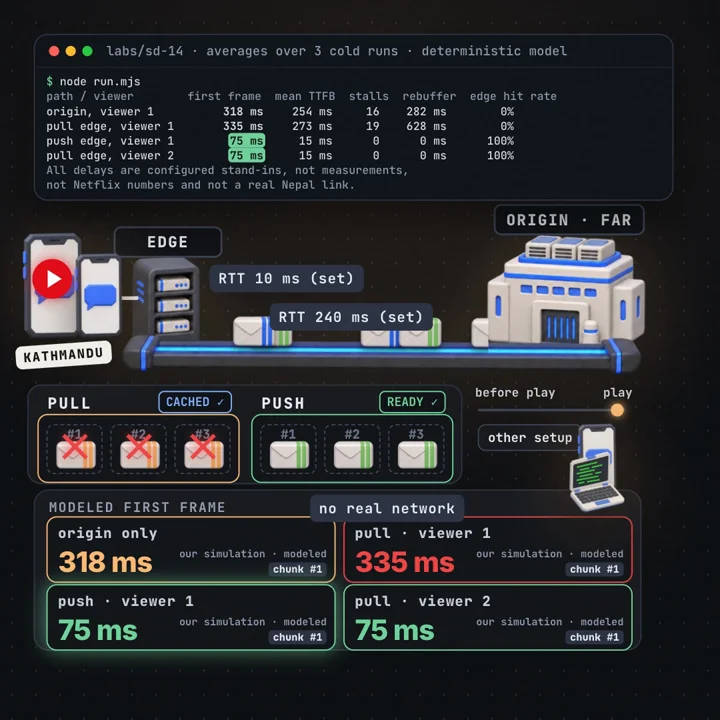
Read the table in three steps. First, the pull edge did not help the first viewer: 0% hits, a modeled startup 17 ms slower than the origin (335 against 318) and more stalls (19 against 16), because each miss adds the edge hop, the miss work and a second server delay. Second, those misses filled the cache, so viewer 2 got 75 ms and no stalls. Third, the push edge gave 75 ms to the very first viewer. With identical bandwidth, the gap comes from where the chunk was stored plus the pull miss cost.
The tight 300 ms lead makes the difference visible; real players buffer many seconds, so real stalls are rarer and depend on sustained delivery rate. The equal 60 ms transfer is a simplification in both directions: on a real path, transfer time depends on whether the connection is already warm, how the congestion controller ramps its window per round trip, and the bottleneck capacity of each path, so the real gap can be larger or smaller than the model shows.
Code
The first snippet is a trimmed version of the lab's edge cache: fixed delays, no jitter, one chunk, a virtual clock (it just adds numbers). Save it as edge_cache.mjs and run node edge_cache.mjs with Node.js 18 or newer. No packages, no network.
// edge_cache.mjs: origin vs pull vs push on a virtual clock (fixed delays we chose, no network)
const D = { originRtt: 250, edgeRtt: 10, edgeToOrigin: 240, missOverhead: 15, server: 5, transfer: 60 };

class Origin {
  constructor() { this.requests = 0; }
  fetch() { this.requests++; return D.originRtt + D.server; }   // time to first byte, ms
}

class EdgeCache {
  constructor(origin) { this.origin = origin; this.store = new Set(); this.hits = 0; this.misses = 0; }
  prefill(ids) { for (const id of ids) this.store.add(id); }      // push: copy in before anyone plays
  fetch(id) {
    if (this.store.has(id)) { this.hits++; return D.edgeRtt + D.server; }   // HIT: short hop only
    this.misses++;                                                          // MISS: pull from origin
    this.origin.requests++;
    this.store.add(id);                                                     // keep it for the next viewer
    return D.edgeRtt + D.missOverhead + D.edgeToOrigin + D.server + D.server;
  }
}

const firstFrame = (path) => path.fetch(0) + D.transfer;   // chunk #1 only

console.log("origin only     ", firstFrame(new Origin()), "ms");

const pull = new EdgeCache(new Origin());
console.log("pull, viewer 1  ", firstFrame(pull), "ms");
console.log("pull, viewer 2  ", firstFrame(pull), "ms");

const push = new EdgeCache(new Origin());
push.prefill([0, 1, 2]);                                    // done earlier, off-peak, in a real system
console.log("push, viewer 1  ", firstFrame(push), "ms");
console.log("origin requests at play time: pull", pull.origin.requests, "| push", push.origin.requests);

// Coalescing: 100 viewers ask for the same cold chunk in the same instant.
function burst(n, coalesce) {
  const origin = new Origin();
  const inFlight = new Map();                               // chunk id -> fetch already running
  for (let i = 0; i < n; i++) {
    if (coalesce && inFlight.has(7)) continue;              // join the running fetch
    inFlight.set(7, origin.fetch(7));
  }
  return origin.requests;
}
console.log("cold burst of 100: origin requests", burst(100, false), "without lock,", burst(100, true), "with lock");
What to observe:
origin only      315 ms
pull, viewer 1   335 ms
pull, viewer 2   75 ms
push, viewer 1   75 ms
origin requests at play time: pull 1 | push 0
cold burst of 100: origin requests 100 without lock, 1 with lock
Without jitter the origin row is the expected 315 ms; the full lab adds ±10% jitter and averages three runs, giving 318 ms. The pull rows show "miss, then hit" for one chunk, and the push edge sent nothing to the origin at play time. Set missOverhead to 0 and the first pull viewer becomes 320 ms, still slower than 315 because of the extra edge hop and server delay. The coalescing line is the ideal case, with an instant burst and a fill that never fails or times out; the Nginx section below shows when real locks let extra requests through. The full lab, labs/sd-14/run.mjs, plays all 20 chunks and counts stalls.
The same ideas in a real cache: this config makes Nginx a small pull edge with coalescing and stale serving (directives from the proxy module docs):
# edge.conf: Nginx as a pull cache in front of a faraway origin
proxy_cache_path /var/cache/edge levels=1:2 keys_zone=video:100m
                 max_size=50g inactive=7d use_temp_path=off;

server {
    listen 80;

    location /video/ {
        proxy_pass https://origin.example.com;
        proxy_cache video;
        proxy_cache_key "$scheme$proxy_host$request_uri";   # the default: keeps the full query string
        proxy_cache_valid 200 206 7d;               # fallback lifetime; upstream cache-control headers take precedence

        proxy_cache_lock on;                        # coalesce concurrent misses for the same key
        proxy_cache_lock_timeout 5s;                # after 5 s a waiter goes upstream, uncached
        proxy_cache_use_stale error timeout updating http_500 http_502 http_503 http_504;
        proxy_cache_background_update on;           # refresh stale copies without making viewers wait

        add_header X-Cache-Status $upstream_cache_status always;   # MISS, HIT, EXPIRED, STALE, UPDATING
    }
}
The cache key is a security boundary. The key above is the documented default, $scheme$proxy_host$request_uri, which includes the query string. A common "optimization" is $scheme$host$uri, which drops every query parameter. That is unsafe: two different representations (say ?rendition=1080p and ?rendition=480p) collide on one key, and with signed URLs, a request carrying a valid signature fills an entry that a later request with an expired or missing signature is then served from cache, because the origin that checked the signature is never asked. Keeping the signature in the key does not fix this either: it only fragments the cache, and expiry is still not enforced once a copy is stored. Protected content needs authorization before the cache lookup, at the edge itself, for example with ngx_http_secure_link_module checking the hash and expiry, or an auth_request subrequest. Only strip a query parameter from the key after you have proven it changes neither the content nor access control (analytics tags such as utm_* are the usual candidates).
Request the same segment twice with curl -sI http://localhost/video/ep1/seg-001.ts and watch X-Cache-Status go from MISS to HIT; compare curl -w '%{time_starttransfer}\n' -o /dev/null -s <url> between the two to see TTFB drop. To "push" with a pull cache, warm it: request every segment of a new title from a script before it is announced. That is the simplest form of cache warming.
How Nginx stores the cache, and sizing it
The directives above hide a storage engine with a specific lifecycle. The mechanics below follow the proxy_cache_path documentation and Nginx's cache implementation; the sizing numbers are our worked assumptions.
Filenames come from an MD5 of the key. Nginx hashes the cache key with MD5 and uses the 32-character hex digest as the filename. levels=1:2 builds a two-level directory tree from the end of the hash: the last character, then the two before it. The docs' example: key hash b7f54b2df7773722d382f4809d65029c is stored at /data/nginx/cache/c/29/b7f54b2df7773722d382f4809d65029c. That spreads files over 16 × 256 = 4,096 directories, so no single directory holds millions of entries.
Metadata lives in shared memory. keys_zone=video:100m creates a shared memory zone, visible to every worker process, holding all active keys and per-entry metadata (validity, last access). The docs give one megabyte as about 8 thousand keys, so 100 MB indexes about 800,000 entries. Inside the zone, entries sit in a red-black tree keyed by the MD5 of the cache key, so a lookup is O(log n) in shared memory, and a queue orders the same entries by last access, which is what eviction walks from the cold end. A hit still touches disk before the body: Nginx opens the file and reads its header (format version, validity times, a CRC32 of the key and the key itself) to validate the entry, and treats a mismatch as a miss. The zone is a second capacity limit beside max_size, so size it from your expected object count, not from disk size.
Fills go through a temporary file, then a rename. An upstream response is first written to a temporary file and then renamed into the cache, so the entry appears on disk only once the body is complete. With use_temp_path=off the temporary file is written inside the cache directory, which keeps the rename on one filesystem (a cheap metadata operation instead of a copy).
Two helper processes manage the lifecycle. The cache loader runs once after startup and walks the cache directory to rebuild the shared-memory metadata from files on disk, in batches (loader_files, default 100 files per iteration, at most loader_threshold 200 ms per iteration, loader_sleep 50 ms between). Objects already on disk are not lost while it runs: during this cold-loading phase, a lookup that finds no entry in shared memory still checks for the file on disk and, if a valid one exists, indexes and serves it on demand. The cost of a restart is therefore extra filesystem work (open and header reads for keys the loader has not reached yet, competing with the loader's own directory walk) and some startup latency, not an automatic drop in hit ratio. The cache manager runs periodically: when total size exceeds max_size (or free space drops below min_free), it removes least recently used data.
Freshness and inactive are different clocks. Freshness (Cache-Control from the origin, else proxy_cache_valid) decides whether an entry can be served without asking upstream. inactive decides whether it stays on disk at all: an entry not accessed within that time is removed regardless of its freshness (default 10 minutes). So with proxy_cache_valid 7d and the default inactive, a segment watched once and then ignored for 11 minutes is gone, despite being fresh for a week. Conversely, an expired but often-accessed entry stays on disk and can be revalidated with a cheap 304. The config above sets inactive=7d so that long-tail segments survive between viewers.
Worked sizing. Assume a 6 Mbit/s rendition and 2-second segments:
segment size  = 6 Mbit/s × 2 s ÷ 8 bits per byte   = 1.5 MB
10,000 segments × 1.5 MB                           = 15 GB   (one rendition, 20,000 s ≈ 5.6 h of video)
max_size=50g is binary: 50 GiB = 50 × 1024³        = 53,687,091,200 bytes
53,687,091,200 ÷ 1,500,000 bytes                   ≈ 35,791 segments
53,687,091,200 ÷ 15,000,000,000 bytes              ≈ 3.58 catalogs
keys needed ≈ 35,791  vs  zone capacity ≈ 800,000  → disk, not the key zone, is the binding limit
Nginx's size parser uses binary multipliers, so g means GiB while media sizes above are decimal. So this 50 GiB edge holds about 3.58 such single-rendition catalogs, before per-file cache headers and filesystem block overhead; plan for less and keep operational headroom below max_size and the disk size. Adaptive bitrate multiplies the footprint: every rendition is a separate set of keys, so three renditions of the same 5.6 hours already need 45 GB if all are watched. Fill bandwidth is the other side. Pushing 15 GB into one edge in a 6-hour off-peak window needs 15 × 8 = 120 Gbit ÷ 21,600 s ≈ 5.6 Mbit/s sustained per edge; across 1,000 edges filled from one shield, that is about 5.6 Gbit/s leaving the shield for six hours.
What to monitor: disk usage against max_size (sitting at the ceiling means the manager is evicting continuously), the rate of MISS for objects that were previously HIT (refills after eviction, the signature of a cache smaller than its working set), byte hit ratio rather than request hit ratio, and upstream request counts per key during launches. All of these come from logging $upstream_cache_status, $request_uri and $body_bytes_sent in the access log.
Failure modes and edge cases
- Cold start after a release. On a pure pull CDN a new title has zero hits everywhere at launch, and the first viewers at each edge all miss together. Detect it as a spike in origin requests right after launch; fix it with pre-positioning, warming, a shield and coalescing.
- Cache stampede on expiry. A popular object expires everywhere at once and the next burst all misses. Use coalescing,
stale-while-revalidate, immutable versioned URLs, or random jitter on TTLs. - Cache key mistakes. A per-user query parameter in the key makes every request unique and the hit ratio collapses; leaving out something that changes the response serves the wrong version, and dropping a signed-URL query string can serve protected content without the check. Review keys and
Varyheaders explicitly, and authorize before the cache lookup. - Caching personal data. A response missing
privatecan be stored in a shared cache and served to another user. Mark authenticated responsesprivateorno-storeand test it. - Eviction churn. If the edge is smaller than the working set, popular objects push each other out under load. Watch eviction rate and byte hit ratio.
- Fill traffic competing with viewers. Pushing uses the same links viewers use, which is why an off-peak fill window, as in the Open Connect overview, matters.
- Origin outage. A pull CDN with short TTLs fails fast when the origin dies, because misses cannot be filled.
stale-if-errorand long TTLs on immutable objects keep the service up; the same availability thinking as in the CAP article on what to return when a link breaks.
Trade-offs
| Option | Good for | Costs you | Use when |
|---|---|---|---|
| Origin only | Simplicity, one copy, instant updates | Long round trips for far viewers, all load on the origin | Small audiences close to the origin, private or uncacheable data |
| Pull CDN | No planning, cache follows real demand, cheap long tail | First request per object per edge pays the full miss, bursts at release | Large catalogs with unpredictable demand, websites, APIs with cacheable responses |
| Push CDN | First viewer is fast, fill can use idle hours | Storage at every edge, a placement system, wasted copies if the guess is wrong | Predictably popular content, big launches, video catalogs with known demand |
| Hybrid: push head, pull tail | Fast first views for what matters, bounded storage | Popularity prediction and two code paths | Skewed popularity where the head is predictable and edge storage cannot hold the whole catalog |
| Origin shield (tiered cache) | Ideally one successful fill per key per shield per residency period (with coalescing), fewer long-haul misses | An extra hop on a full miss, another layer to run | Many edges, an expensive or fragile origin |
| Long TTLs with versioned URLs | Avoids update-driven invalidation, no purges; hit ratio still depends on residency, demand and capacity | A build step that renames files | Video segments, scripts, styles, images |
Common mistakes
In an interview
- Clarify: video or small files? On demand or live? How many regions, how big is the catalog, how skewed is popularity?
- Assumptions: state round trips to the origin and to an edge, segment size and duration, and say they are assumptions.
- Structure: player and manifest, routing to an edge, edge cache, optional shield, origin; push fill path beside the pull path.
- Deep dive: miss cost, hit ratio arithmetic, cache keys and
Cache-Control, coalescing, what is pushed and when. - Trade-offs: storage versus first-view latency, freshness versus hit ratio, shield hop versus origin protection.
- Wrap up: most requests are hits from nearby; the design work is making the first request for important content a hit too, without wasting storage.
Distance sets the floor on latency, so a viewer far from the origin pays a long round trip on every video segment. A CDN puts edge caches near viewers; a player fetches the manifest and then each segment as a plain HTTP object, so an edge can serve it from a local copy. In a pull CDN the edge fetches on the first miss and keeps the copy, so the first viewer of each object at each edge still pays the origin trip plus miss work; in a small deterministic model with delays I chose, that was 335 ms of modeled startup, waiting for the whole first segment, against 318 ms from the origin alone, while the second viewer got 75 ms. In a push CDN, content is placed before play, so even the first viewer gets 75 ms; Netflix's Open Connect overview says they place content ahead of time, mostly off-peak. When the head is predictable, a hybrid pushes it and pulls the long tail; an origin shield and request coalescing cut origin fills, and long TTLs on versioned segment URLs avoid purges. I would watch byte hit ratio, origin request rate per key, eviction-driven refills and startup time broken into manifest, licence and first-segment parts.
Practice
BeginnerWhat is the difference between a pull CDN and a push CDN?
A pull edge fetches an object from the origin on the first request that misses and keeps it. A push edge gets the object copied in before anyone asks, so even the first request is a hit.
BeginnerWhy can HTTP caches serve video at all?
Streaming formats such as HLS and DASH cut video into short segments listed in a manifest, and each segment is fetched with a normal HTTP GET. A segment is just a cacheable object with a URL.
IntermediateWith an edge 10 ms away, an origin 240 ms beyond it, 15 ms of miss work and 5 ms per server, what is the TTFB of a miss and of a hit?
Miss: 10 + 15 + 240 + 5 + 5 = 275 ms. Hit: 10 + 5 = 15 ms. In our model the mean values over all chunks were 273 ms and 15 ms.
IntermediateA hit costs 15 ms and a miss 273 ms. What is the expected TTFB at 90% and at 99% hit ratio, and how does origin load change?
At 90%: 13.5 + 27.3 = 40.8 ms. At 99%: 14.85 + 2.73 = 17.58 ms. Origin requests fall from 10% to 1% of edge requests, a tenfold drop.
IntermediateWhy was the first pull viewer slower than the origin alone in our model?
A miss pays everything the origin path pays plus the hop to the edge, the 15 ms miss overhead and a second server delay. So modeled startup was 335 ms against 318 ms, and with the 300 ms lead every later chunk stalled (19 stalls against 16).
AdvancedA new episode launches and origin traffic spikes tenfold for ten minutes. What happened and what do you change?
Every edge missed the new segments at once (a cold start, possibly with stampedes). Pre-position the release to edges in an off-peak fill window, warm caches, enable request coalescing at edges and shields, and put a shield in front of the origin so that, ideally, there is one successful fill per cache key per shield per residency period. Check that fills finish inside the lock timeout (5 s in the config above); if not, waiters go upstream and the spike persists.
AdvancedYour edge hit ratio dropped from 95% to 40% after a deploy, with no traffic change. Where do you look?
The cache key and the response headers. A new query parameter or a header added to `Vary` can make every request unique; a `Cache-Control: private` or `no-store` added by mistake stops caching entirely. Compare logged `$upstream_cache_status` distributions, cache keys and `Cache-Control` before and after, and check the access log for which keys changed from `HIT` to `MISS`.
AdvancedHow do you publish a corrected video segment without purging thousands of edges?
Encode it under a new URL (version or content hash in the path) and publish a new manifest that points to it. Old segments stay valid and immutable; only the manifest needs a short TTL or a version of its own.
Cheat sheet
| Term or formula | Meaning |
|---|---|
| Origin | The authoritative copy; every cache fills from it |
| Edge server | Cache near viewers; answers hits locally |
| Pull | Fetch on the first miss, keep for the next viewer |
| Push (pre-positioning, warming) | Copy in before anyone asks |
| Miss TTFB | edge hop + miss work + origin hop + server times |
| Hit TTFB | edge hop + edge server time |
| E[TTFB] = h × hit + (1 − h) × miss | Average latency at hit ratio h |
| Origin load ≈ (1 − h) × requests | Single tier, no coalescing, revalidation, warming or shield |
| Stall when buffer reaches 0 | Depends on buffered seconds and sustained delivery rate; our lab simplifies to TTFB + transfer > lead |
| Segment size = bitrate × duration ÷ 8 | 6 Mbit/s × 2 s ÷ 8 = 1.5 MB; 10,000 segments = 15 GB |
| Nginx inactive vs freshness | Unaccessed entries are removed after inactive even if fresh |
| Cache-Control: s-maxage / max-age | Freshness for shared caches / all caches (RFC 9111) |
| Age | Seconds since generation or validation at the origin; Age: 0 can still be a hit |
| Cache key | Keep the query string by default; authorize before the cache lookup |
| stale-while-revalidate | Serve stale now, refresh in the background |
| Origin shield | Middle cache tier; ideally one successful fill per key per shield per residency period |
| Request coalescing | Simultaneous misses wait for one fill (proxy_cache_lock); waiters go upstream after the 5 s lock timeout |
| Our model (modeled startup) | origin 318 ms, pull viewer 1 335 ms, pull viewer 2 75 ms, push viewer 1 75 ms |
Further reading
- Netflix Open Connect Overview (PDF): the public description of Open Connect, including proactive content placement and the off-peak fill window.
- Netflix Open Connect: the program's site, with material for internet providers that host appliances.
- RFC 9111, HTTP Caching: the rules every shared cache follows: freshness, age calculation, validation and
Cache-Controldirectives. - MDN, Cache-Control: a readable reference for each directive, including
immutable,stale-while-revalidateandstale-if-error. - Cloudflare Learning, What is a CDN?: an overview of edges, routing and why distance matters, with diagrams.
- Nginx ngx_http_proxy_module: the exact meaning of
proxy_cache,proxy_cache_lock,proxy_cache_use_staleand related directives used in the config above.
This article describes general CDN and HTTP caching behaviour and our own small simulation. Apart from the one cited statement from Netflix's public Open Connect overview, it does not describe any company's private systems, and the diagrams are conceptual. The simulated numbers come from a deterministic model with delays we chose; they show the shape of the effect, not measurements of Netflix, of any CDN or of any network in Nepal.
Frequently asked questions
What is a CDN in simple words?
A content delivery network is a set of servers spread across many cities that keep copies of a site's files, images or video. Your request goes to a nearby copy instead of the faraway origin server, so each round trip is short and the origin handles far fewer requests.
What is the difference between a push CDN and a pull CDN?
A pull CDN fetches a file from the origin the first time someone asks for it and then keeps it, so the first request is slow and later ones are fast. A push CDN has the content copied to the edge before anyone asks, so even the first request is fast, at the cost of storage and planning which content to place.
Why does Netflix not buffer even far from its data centers?
Netflix's Open Connect overview says content is placed on Open Connect appliances near viewers ahead of time, mostly during off-peak hours. So when you press play, the video usually comes from a nearby box rather than from far away. Other details of their system are not covered here.
Is a pull CDN slower than no CDN for the first viewer?
It can be slightly slower for that one request. On a miss the edge must go to the origin and also spend time looking up and storing the object. In our model the first pull viewer's modeled startup was 335 ms against 318 ms from the origin alone. Later viewers of those cached chunks through that edge got 75 ms.
What is a good cache hit ratio for a CDN?
There is no universal target; it depends on catalog size, popularity skew, cache size and TTLs. Work it out instead: in a simple single-tier model, expected time to first byte is hit ratio times hit cost plus miss ratio times miss cost, and origin requests are the miss ratio times edge requests, before coalescing, revalidation, warming or shields change that.
What is an origin shield?
An origin shield, or tiered cache, is a middle cache layer between many edges and the origin. When an edge misses, it asks the shield first. Ideally the origin then sees one successful fill per cache key per shield per residency period, with effective request coalescing; expiry, eviction, failed fills and lock timeouts add more origin requests.
Sources
- Netflix Open Connect Overview (PDF)openconnect.netflix.com
- Netflix Open Connectopenconnect.netflix.com
- RFC 9111: HTTP Cachingrfc-editor.org
- MDN: Cache-Control headerdeveloper.mozilla.org
- Cloudflare Learning: What is a CDN?cloudflare.com
- Nginx: ngx_http_proxy_module (proxy_cache, proxy_cache_path, proxy_cache_lock)nginx.org
- RFC 9111 section 4.2.3: Calculating Agehttpwg.org
Linked from

Written by a software engineer and system architect with 10+ years of building production web, payment, ticketing and accounting systems in Japan and Nepal. About us