Claude Fable 5.2 review: benchmarks, demos, Mythos 5.2 and how to use it
Claude Fable 5.2 and Mythos 5.2: specs, every benchmark vs Fable 5.1 and Opus 5.5, the OS and Fermat demos, how to use it, and what it changes.
Drafted with AI assistance, then checked and edited by a human engineer · How we write
Claude Fable 5.2, released by Anthropic on November 9, 2026, beats Opus 5.5 on almost every benchmark Anthropic published, with the largest gains in robot control (64.9% vs 39.4%) and real remote work (41.3% vs 21.3%). Mythos 5.2 is the same model with relaxed safeguards for vetted organisations.
What is new in Claude Fable 5.2
- Anthropic says it is "a step above Opus 5.5 in almost all the capabilities we evaluated" (launch post).
- Output is up to 30% faster than Fable 5.1 and Mythos 5.1.
- The product page calls it Anthropic's "strongest lead agent", able to coordinate hundreds or more than a thousand subagents.
- Beyond code, the launch shows a booting operating system, a formalized Fermat proof, working electronics and robot control.
Fable 5.2 vs Mythos 5.2: what is the difference?
They are the same underlying model. The difference is the safeguards:
| Fable 5.2 | Mythos 5.2 | |
|---|---|---|
| Model | Same | Same |
| Cyber and biology safeguards | Strong | Relaxed |
| Who can use it | Paid Claude plans and the API | Organisations approved through the Cyber Verification Program or the Life Sciences Verification Program |
| Blocked requests | Answered by Opus 4.8 (cyber) or Opus 5 (biology) | Not blocked in those areas |
Claude Fable 5.2 specs
| Item | Fable 5.2 |
|---|---|
| Context window | 1M tokens |
| Max output | 128K tokens |
| Thinking | Adaptive, always on |
| Speed | Up to 30% faster than 5.1 |
| Data retention | 30 days required; zero retention only with Anthropic's express authorization |
| Plans | Pro, Max, Ultra, Team, Enterprise |
| API model id | claude-fable-5-2 |
| Cloud | Amazon Web Services, Google Cloud, Microsoft Foundry |
From the release notes and the product page. A 1M context matters most for agents, because every turn re-sends the history (why agent input grows each turn).
Is Fable 5.2 better than Opus 5.5? The benchmarks
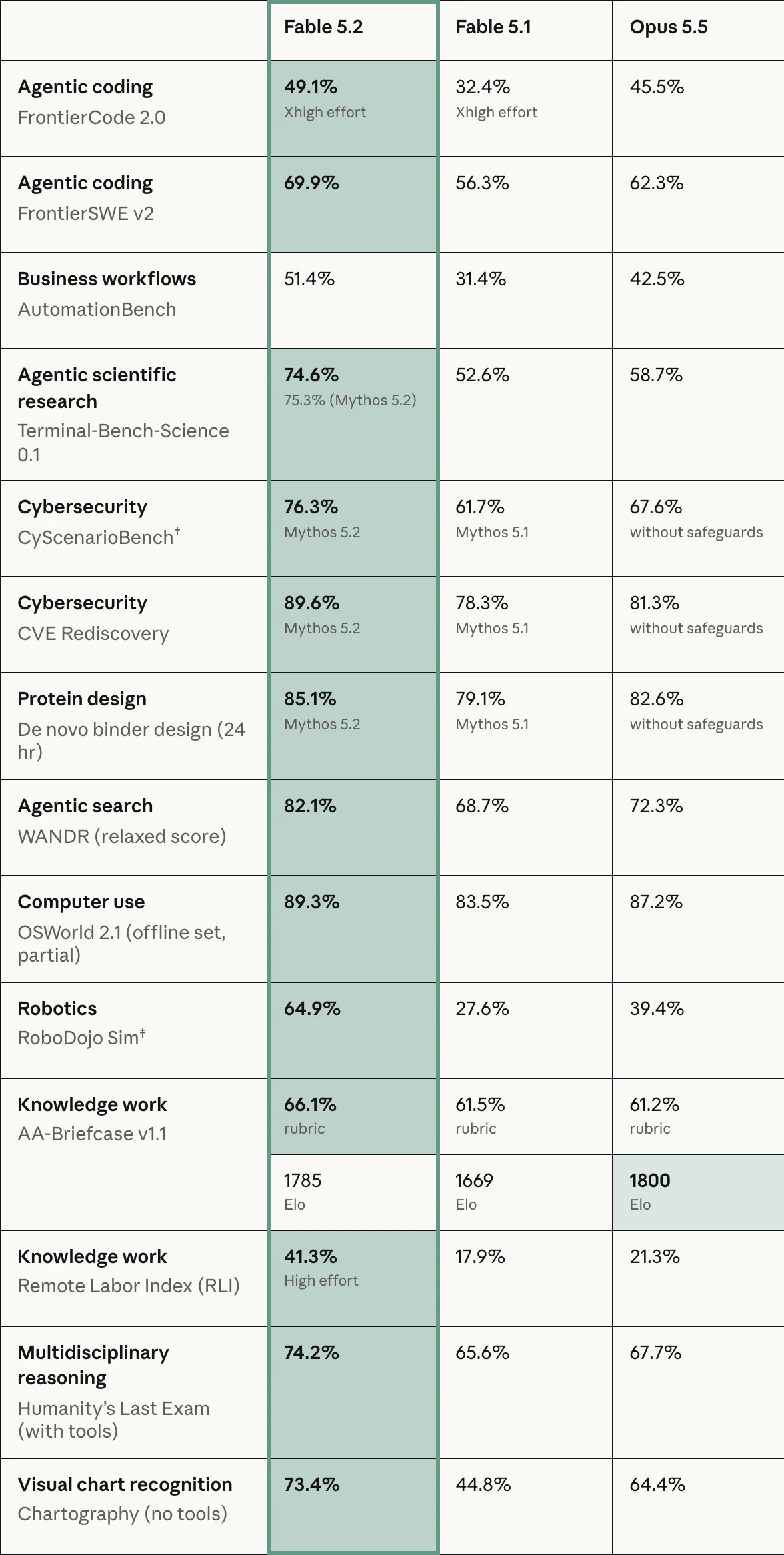
Yes, on almost every test. The rows that moved most:
| Test | Fable 5.2 | Opus 5.5 | Gain |
|---|---|---|---|
| RoboDojo Sim (robot control) | 64.9% | 39.4% | +25.5 |
| Remote Labor Index (real remote jobs) | 41.3% | 21.3% | +20.0 |
| Terminal-Bench-Science | 74.6% | 58.7% | +15.9 |
| WANDR (agentic search) | 82.1% | 72.3% | +9.8 |
| AutomationBench (business workflows) | 51.4% | 42.5% | +8.9 |
| FrontierSWE v2 (long software tasks) | 69.9% | 62.3% | +7.6 |
| Humanity's Last Exam (with tools) | 74.2% | 67.7% | +6.5 |
| FrontierCode 2.0 (extra high effort) | 49.1% | 45.5% | +3.6 |
| OSWorld 2.1 (computer use) | 89.3% | 87.2% | +2.1 |
One row goes the other way: on AA-Briefcase, Fable scores higher on the rubric (66.1% vs 61.2%) but Opus 5.5 keeps a slightly higher Elo (1800 vs 1785).
What Fable 5.2 built: OS, Fermat proof, hardware, robots
All from Anthropic's launch post; none has an outside check yet.
| Demo | What happened |
|---|---|
| Operating system | One engineer set the task from an empty folder; Fable 5.2 coordinated 1,000+ subagents for 8 days. It boots on a laptop with its own kernel, drivers, file storage, windows, login screen and installer. No public code yet. |
| Fermat's Last Theorem | 1,000 Fable 5.2 agents fully formalized the proof in Lean in 30 hours. Opus 5.5 reached 26% in 18 hours. |
| Hardware | From one paragraph: a home voice assistant hub, a USB speakerphone and a handheld virtual pet, with circuit boards, 3D-printed cases and software. All three worked without electrical fixes. |
| Robots | Robot arms solved a puzzle cube, unscrewed a bottle cap and drew a picture, on tasks the model was never explicitly trained for. |
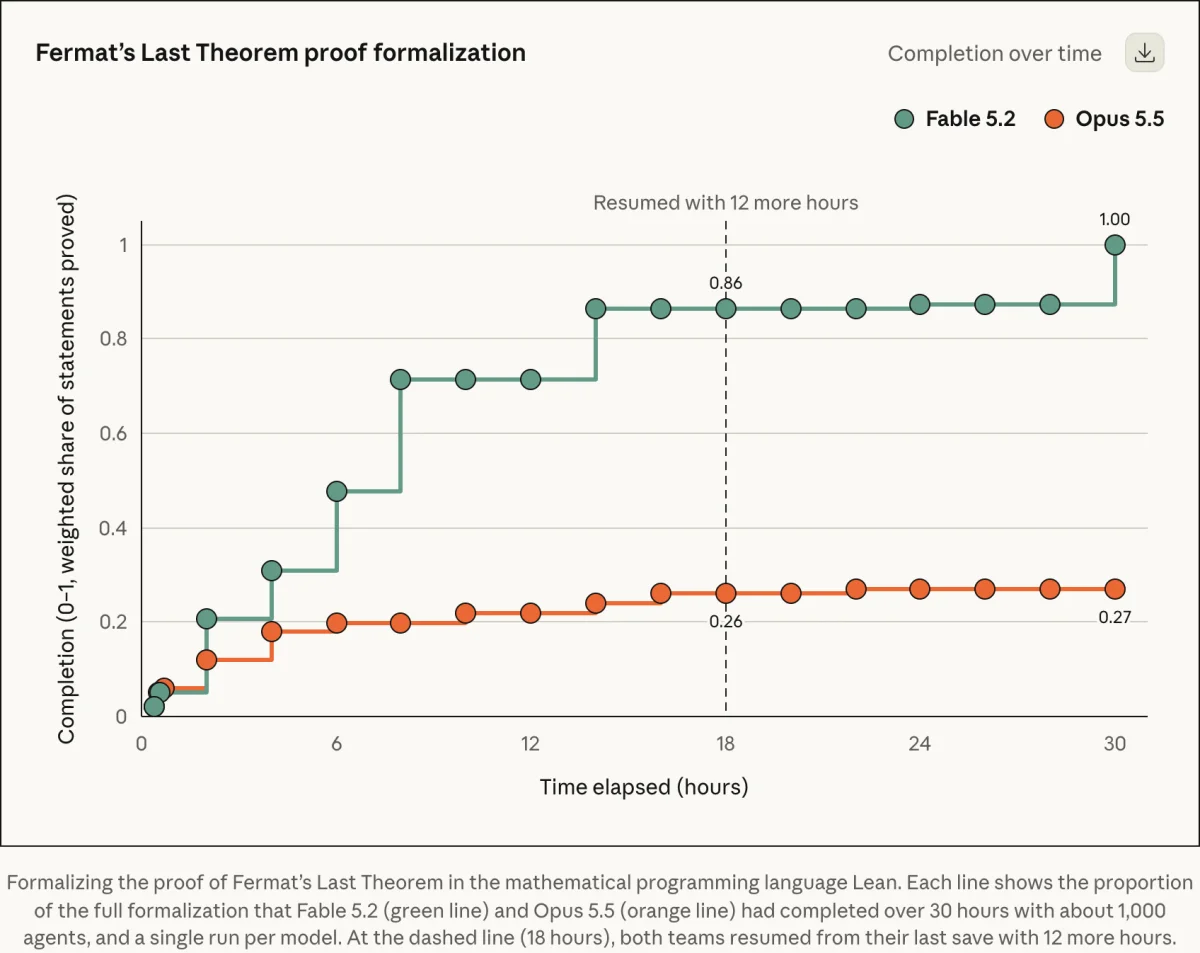
Opus 5.5 flattens at 26 to 27% and never recovers, while Fable keeps climbing to 100%. A Lean proof either checks or it does not, so this is the most verifiable result in the launch.
How to use Claude Fable 5.2
- In the Claude apps, pick Fable 5.2 in the model menu on a Pro, Max, Ultra, Team or Enterprise plan. On Pro and standard Team seats, Fable can use up to 50% of the weekly usage limit (how weekly limits work: Claude Ultra limits).
- On the API, call model
claude-fable-5-2. Thinking is always on and adapts to the task, so you do not set a thinking budget. - In a coding agent, the model is just a setting; the workflow around it stays the same, whether you run Claude Code, Codex CLI or both. Reusable instructions travel as agent skills, so the skills you already use load the same way with Fable.
- You can also keep Opus 5.5 as the main model and let Fable 5.2 advise only at key moments: see the Claude Code advisor setup.
- Anthropic says to start with Opus 5.5 and move to Fable 5.2 when the task is long and hard enough to need it: long agent runs, large refactors, work you would split across many workers (how to set up Claude for that kind of work).
- Plan for the 30-day retention requirement if your team normally runs with zero retention.
Safety and the skills Anthropic held back
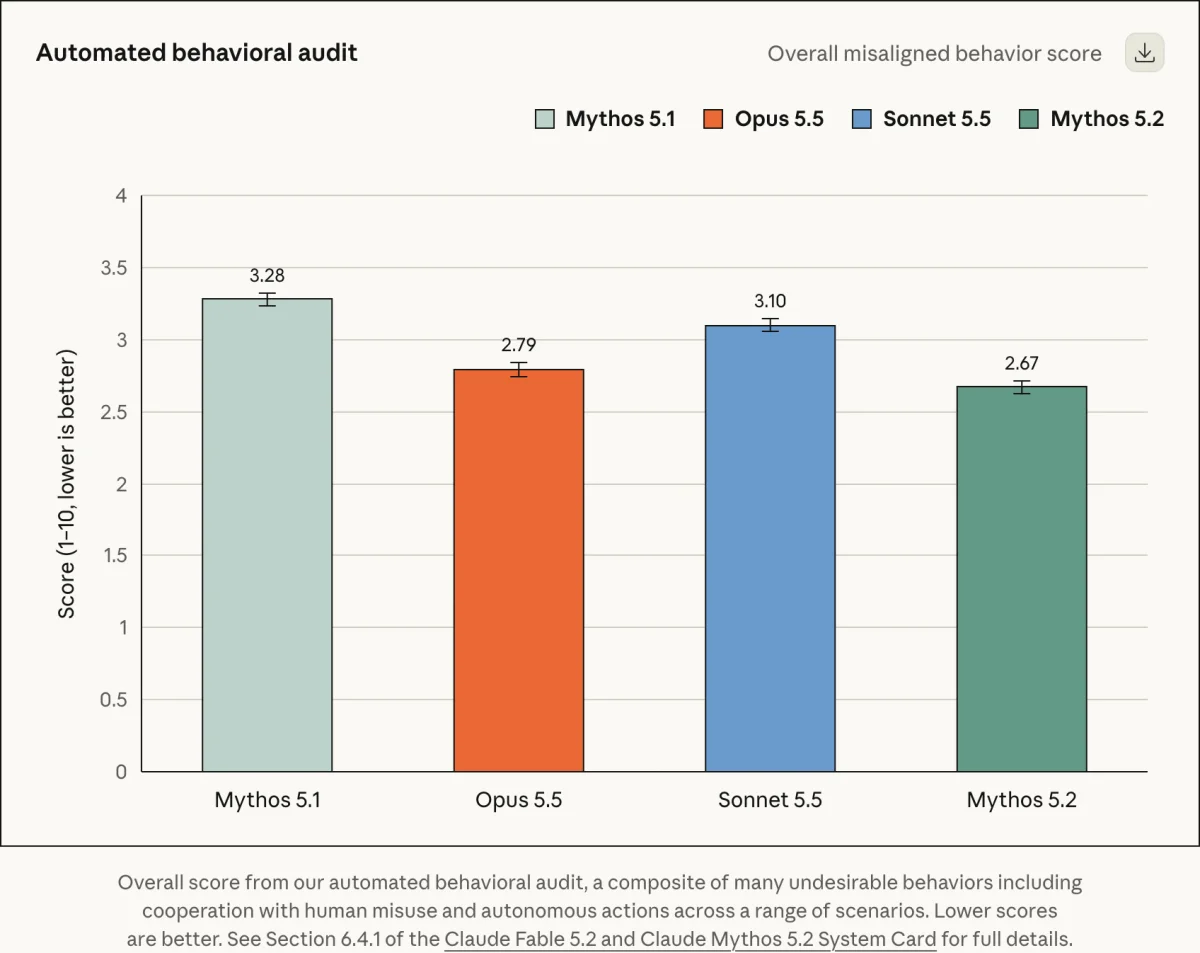
Anthropic limited two skills during training on purpose: accelerator kernel optimisation and improving language model architectures, the skills that most directly speed up AI research. On those, Fable 5.2 performs at about the level of Opus 5.5. The limit was set in training, so you get no refusal or warning when you reach it, only Opus 5.5 level results.
What Fable 5.2 changes, and for whom
| Who | What changes |
|---|---|
| Developers | The job you can hand off grows from a function to a project (Remote Labor Index 41.3% vs 21.3% for Opus 5.5). The hard part moves to specs and checks: saying exactly what you want, splitting the work, and verifying it with tests, CI and a second AI that reviews the first. What an agent is allowed to touch matters more, not less. |
| Researchers and scientists | Proof checking and long analysis runs become practical: the Fermat proof was formalized in Lean in 30 hours, and Terminal-Bench-Science rose from 58.7% to 74.6%. Life science and security teams can apply for Mythos. |
| Office and remote work | Business workflows (AutomationBench 51.4% vs 42.5%) and real remote projects are where it gained most, so multi-step jobs like reports, data clean-up and research can run with less hand-holding. |
| Hardware makers and students | One paragraph produced three working devices, circuit boards and cases included, and robot arms handled tasks they were never trained for. Prototyping gets faster for anyone who can describe what they want clearly. |
| Everyone using Claude | Start on Opus 5.5 for daily work, move to Fable 5.2 for the long, hard jobs, and expect the skill that matters most to be describing the job and checking the result. |
Under all of these sits the same design: one strong coordinator, many workers, and a check on every result. Knowing how agents hand work to each other and how thousands of writers update one repository without collisions is what turns a strong model into a working product.
Benchmarks and demos are Anthropic's published results, checked on November 10, 2026.
Frequently asked questions
What is the difference between Claude Fable 5.2 and Mythos 5.2?
They are the same underlying model. Fable 5.2 keeps strong cybersecurity and biology safeguards and is open to paid Claude plans; Mythos 5.2 relaxes those safeguards and is limited to organisations approved through Anthropic's Cyber or Life Sciences Verification Programs.
Is Claude Fable 5.2 better than Opus 5.5?
On Anthropic's published benchmarks, yes, on almost every test: for example 69.9% vs 62.3% on FrontierSWE v2 and 41.3% vs 21.3% on the Remote Labor Index. Opus 5.5 keeps a slightly higher AA-Briefcase Elo (1800 vs 1785). Anthropic still recommends starting with Opus 5.5 and moving to Fable for the hardest tasks.
How do I use Claude Fable 5.2?
Choose it in the model menu on a Pro, Max, Ultra, Team or Enterprise plan, or call the model id claude-fable-5-2 on the Claude API. Thinking is always on and adaptive. It is also on Amazon Web Services, Google Cloud and Microsoft Foundry.
Did Claude Fable 5.2 really build an operating system?
Anthropic says one engineer set the task from an empty folder and Fable 5.2 coordinated more than 1,000 subagents for 8 days to build a prototype OS that boots on a laptop. As of November 10, 2026 there is no public code to run, so it is a company demo for now.
Sources
- Anthropic: Introducing Claude Fable 5.2 and Claude Mythos 5.2anthropic.com
- Claude Platform release notesplatform.claude.com
- Anthropic: Claude Fable product pageanthropic.com

Written by a software engineer and system architect with 10+ years of building production web, payment, ticketing and accounting systems in Japan and Nepal. About us