AI SystemsSystem Design, simply · AI 7
AI agent tokens: why history makes total input grow
AI agent tokens add up: each call carries the retained history as input, so an append-only task grows close to N squared. The math, KV caching and trimming.
Drafted with AI assistance, then checked and edited by a human engineer · How we write
Short answer
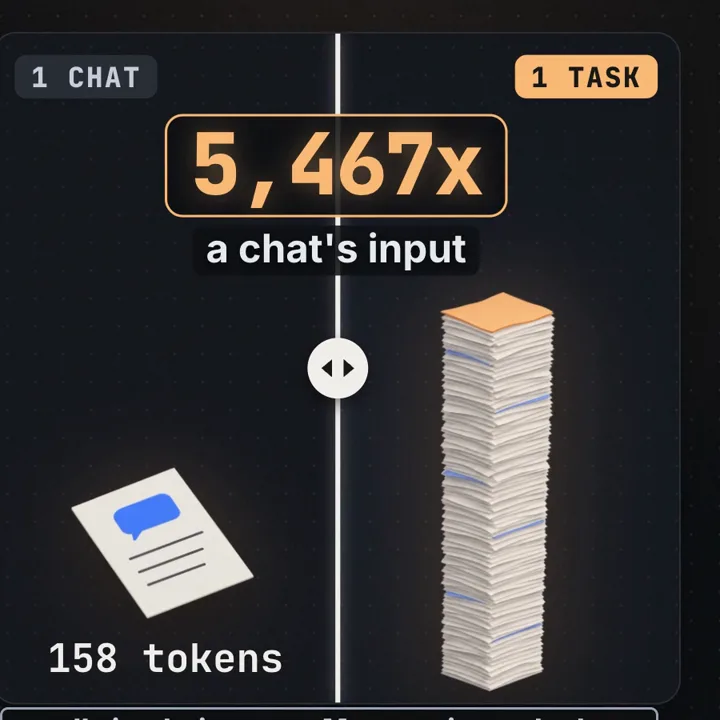
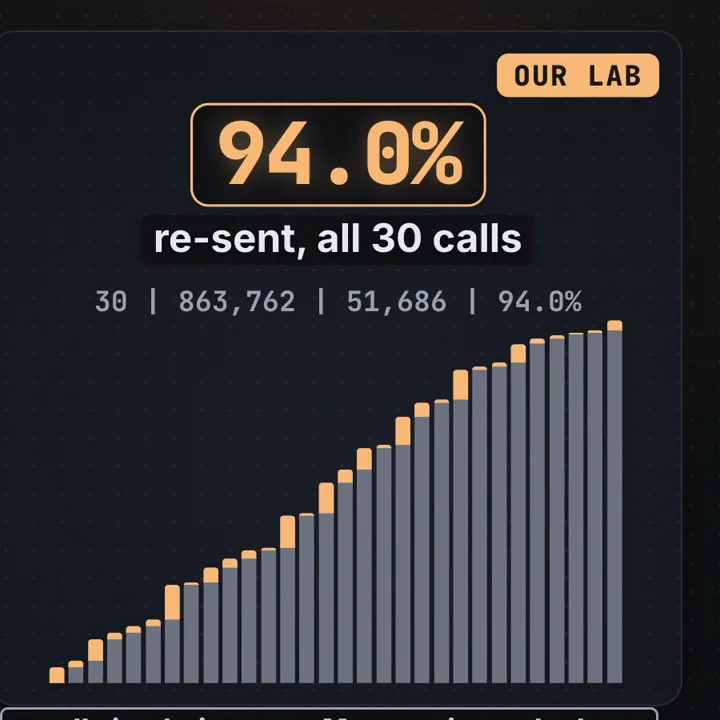
In an append-only agent loop each model call takes the retained history as input, uploaded by the client or rebuilt from stored state. With steady increments, total input rises close to N squared. In our synthetic lab a 30-call task sent 863,762 estimated input tokens, 5,467x one chat, and 94.0% of it was re-sent history. Caching cut illustrative cost 82%, same tokens.
| Root cause | In an append-only loop, call k takes the fixed part plus every message from calls 1 to k-1 as input, whether the client uploads it or the service rebuilds it from stored state. Old tool results are billed as input again on every later call |
|---|---|
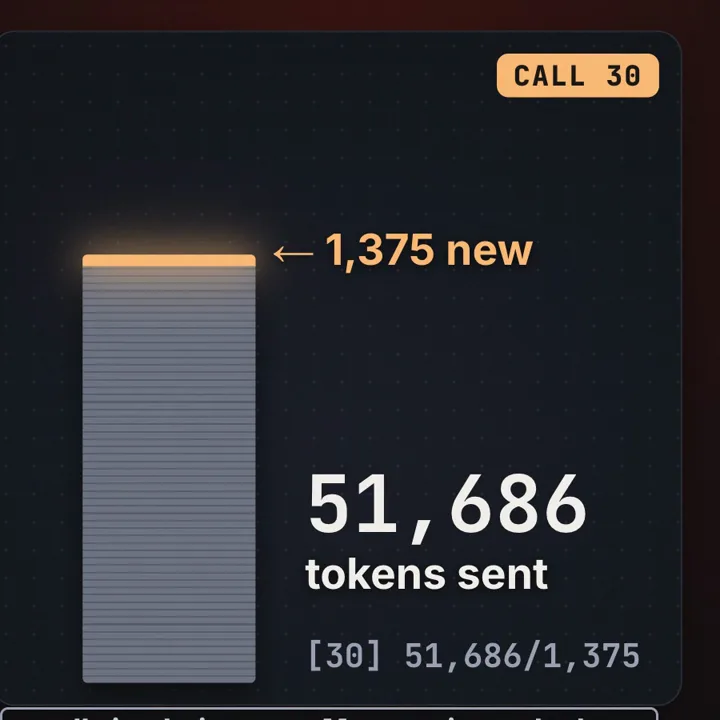
| Request sizes (lab, medium profile) | Request 1 is the fixed part, 2,230 estimated tokens. Request 30 is 51,686 tokens, of which only 1,375 are new |
| Total and share (lab, 30 calls) | 863,762 estimated input tokens in total, 5,467x one chat's 158 input tokens. 94.0% of it is history sent again |
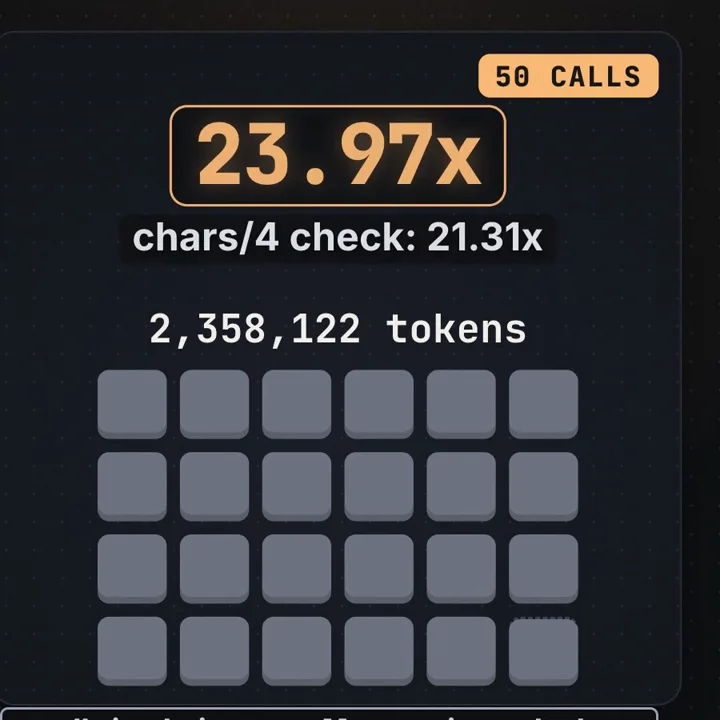
| Growth | From 10 to 50 calls total input grows 23.97x (21.31x with a chars/4 estimator). Growth exponent 1.97, where 1 is a straight line and 2 is a square |
| Three multiples, not one | At 30 calls: read multiple 5,467x, input plus output 1,141x, illustrative cost 277x. Output is priced 5x input in the illustrative price list and a chat is mostly output |
| Trimming tool results (lab profiles) | Keeping 20%, 50% or 100% of each tool output gives 136x, 277x and 504x one chat's illustrative cost at 30 calls. The re-sent share stays near 94% |
| Prompt caching (illustrative prices) | Cost at 30 calls falls from $2.63 to $0.4733, an 82% saving. The token count does not change; re-sent tokens are billed at a cache-read price |
AI agent tokens pile up for a structural reason. In an append-only agent loop, each model invocation includes the retained conversation as logical context: the client can upload it, or the service can reconstruct it from stored conversation state. Either way the input of call k is everything before it, so with roughly constant increments total input across N calls grows close to N squared, and most of it is old tool output counted again. Interview version: "Your coding agent's input token count is 5,000 times a chat. Where did the tokens go, and how do you bring the bill down?"
Prerequisites
The model keeps no memory between invocations. Each invocation computes over the system prompt, tool definitions and messages that make up its context, and nothing else. A multi-turn conversation exists because earlier turns are put back into that context, either uploaded again by the client or rebuilt by the service from stored conversation state. The context window article (AI 3) shows the app rebuilding that list on every turn and what happens when it no longer fits.
Tool calling. A model cannot read a file or run a test. It writes a structured request naming a tool and its arguments, the app runs the tool, and the result goes back to the model as a new message. The tool calling article (AI 5) walks through that loop. An agent is that loop repeated until the model writes a final answer instead of a tool call.
Tokens and prices. APIs bill input tokens (what you send) and output tokens (what the model writes) at separate prices per million; output usually costs more. Counts depend on each model's tokenizer, so any other count is an estimate.
Definitions
Agent loop: a client loop that calls a model, runs any tool the model requests, appends the request and its result to the message list, and calls the model again, until the model returns a final answer.
Fixed part (F): the content sent identically on every call of a task: system prompt, tool schemas and the task text, plus serialization framing. In the lab it is request 1, 2,230 estimated tokens.
Increment (ak): the tokens that call k adds to the history, its model message plus the tool result. They first appear in request k+1 and then in every later request.
Re-sent share: the fraction of a task's total input tokens that had already been sent in an earlier request of the same task.
Read multiple, combined multiple, cost multiple: agent input divided by chat input; agent input plus output divided by chat input plus output; agent cost divided by chat cost. Each ratio answers a different question.
Prompt caching: a provider feature that stores the key/value tensors computed for a request prefix and reuses them when a later request starts with exactly the same prefix, billing those tokens at a cache-read price. The model still receives the full context.
Compaction and context editing: removing, clearing or summarizing parts of history that are already saved, so later requests carry less. This is a separate technique from making new tool results smaller before they enter history.
How does an agent re-send its history?
The lab behind this article (labs/ai-7) builds a toy coding agent. It is a synthetic simulation with estimated tokens, not a billed run and not any product's real numbers. Every request is serialized as one JSON body with system, tools and messages, in the shape of common chat APIs, and counted as a whole, framing included. Every count in this article is therefore a synthetic JSON-size token estimate that includes JSON keys, quotes and escaping. Real APIs do not tokenize the HTTP body; they render messages and tool definitions into a model-specific input format with its own control tokens, so even a real tokenizer run over the raw request JSON would not give billable usage. For production accounting use the provider's token-counting endpoint before a call and the usage object it returns after. The estimates are fine for ratios and shape, which is what the lab claims.
request 1   [system][10 tool schemas][task]
request 2   [system][10 tool schemas][task][msg 1][result 1]
request 3   [system][10 tool schemas][task][msg 1][result 1][msg 2][result 2]
...
request k   [fixed part F][everything from calls 1 .. k-1]
Calls 1 to N-1 each write a short message and one tool call (read_file, grep, run_tests, edit_file, list_dir); the tool result joins the history. Call N writes the final answer. Nothing is ever removed: the loop is append-only, which is the condition for everything that follows.
Who holds the history is a separate question from what the model computes over. The OpenAI conversation state guide describes both modes: pass earlier messages again yourself, or chain to a stored response with previous_response_id, in which case the guide states all previous input tokens in the chain are still billed as input. Server-side state saves upload bytes; it does not shrink the logical context.
Why the logical context has to be there on every call comes from how a transformer serves a request, in two phases:
- Prefill. All input tokens go through every layer in parallel. Each layer projects every token into a key vector and a value vector, and each token attends to all earlier ones. The result is the KV cache: per layer, a key tensor and a value tensor with one row per token. Cost has a part linear in the input length L (projections and MLP, about 2 FLOPs per parameter per token) and a quadratic attention part (scores between every pair of tokens, about 2·layers·L²·dmodel FLOPs with a causal mask).
- Decode. Output tokens are generated one at a time. Each new token computes its own query, key and value, attends over the stored KV cache and appends one row. Decode cost per output token is linear in L and is usually limited by memory bandwidth, because the whole KV cache is read for every generated token.
The KV cache is per request. When the request ends the server frees it (or keeps parts of it under prompt caching, below), so call 20 cannot use anything computed on call 4 unless the same prefix is still cached. Some worked numbers for an 8B-class open model with grouped-query attention (32 layers, 8 KV heads, head dimension 128, 16-bit values, about 8 billion parameters, dmodel 4,096); this is a public open-weight shape used as an example, not any provider's served model:
KV bytes per token  = 2 (K and V) × 32 layers × 8 heads × 128 dims × 2 bytes = 131,072 B = 128 KiB
request 30 (51,686) = 51,686 × 131,072 B = 6,774,587,392 B ≈ 6.31 GiB of KV state

prefill FLOPs, linear part    ≈ 2 × 8e9 × L
prefill FLOPs, attention part ≈ 2 × 32 × L² × 4,096
attention / linear            ≈ 32 × 4,096 × L / 8e9 = L / 61,035
at L = 51,686                 ≈ 0.85, so attention is already close to half of prefill
So "the model reads every token" hides three different costs: upload bytes (zero for server-held history), prefill compute (superlinear in uncached L), and KV memory plus decode bandwidth (linear in L). A prefix cache removes the prefill for the cached part: only the new tail is projected, and each new token still attends over the full context. Open-source servers show how this works inside: vLLM's automatic prefix caching splits the KV cache into fixed-size blocks, keys each block by a hash of its tokens plus the hash of the block before it (so a block only matches if the whole prefix matches), and evicts unreferenced blocks in LRU order. Because the hash is chained, one changed byte early in a prompt invalidates everything after it.
Here is the lab's medium profile, request by request (full size / new tokens in it):
[1]  2,230 / 2,230    [10] 17,747 / 1,261    [20] 39,949 / 2,003    [30] 51,686 / 1,375
[2]  3,123 /   893    [11] 18,894 / 1,147    [21] 40,455 /   506
[3]  6,190 / 3,067    [12] 19,304 /   410    [22] 44,603 / 4,148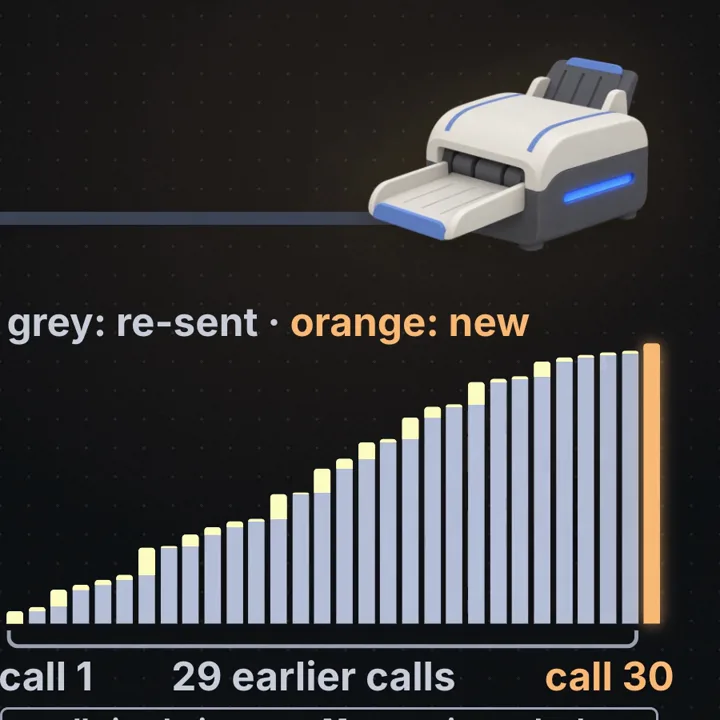
The new part is small and noisy (319 to 4,942 tokens in requests 2 to 30, by tool). The full size only goes up. Request 30 is 51,686 tokens, and 1,375 of them are new: the tool result and message from call 29 plus framing. The other 50,311 tokens, exactly the size of request 29, are copies.
Why do AI agent tokens grow close to N squared?
Let Rk be the size of request k. With a fixed part F, increments a1 .. aN-1 and nothing removed:
R_k  = F + a_1 + a_2 + ... + a_(k-1)

Exact (any increments):
T(N) = R_1 + R_2 + ... + R_N
     = N·F + sum over j=1..N-1 of a_j · (N - j)   (step j is re-sent in N - j later requests)

Constant-increment approximation (a_j = a for all j):
T(N) = N·F + a·N(N - 1)/2                         (an arithmetic series)
S(N) = 1 - [F + (N - 1)·a] / T(N)                 (re-sent share)
The exact sum is a weighted sum: increment j has weight N - j. Plugging an ordinary average of the aj into the approximation is exact only if the increments are evenly spread; a large result early in the task (high weight) pushes the real total above the approximation, a large one late pushes it below. The first term is linear in N, the second quadratic: the fixed part dominates short tasks, the history term long ones. Early tool output is the most expensive: a large file read on call 2 of a 30-call task is sent in 28 later requests (requests 3 to 30).
Two identities follow from this.
New tokens telescope. The new tokens in request k are Rk minus Rk-1, so their sum over the whole task is RN, the size of the last request. In the lab at 30 calls: total new input is 51,686, which is request 30. Everything else in the total was sent before.
Re-sent share approaches 1 - 2/N when the history term dominates. Re-sent share is exactly 1 - RN / T(N). Under the constant-increment approximation, once (N-1)·a is much larger than F, RN is about aN and T(N) about aN²/2, so S approaches 1 - 2/N. At N = 30 that is 1 - 2/30 = 93.3%. The lab measured:
re-sent share = 1 - R_30 / T(30) = 1 - 51,686 / 863,762 = 1 - 0.0598 = 94.0%The share depends on N, on the ratio F / a and on how the increments are spread over the task. Scaling the increments alone can change S, because F is unchanged: smaller increments make the fixed part a larger share of every request. In the lab F is small next to the history by call 30, so the three trimming profiles below land within 0.2 points of each other (94.1%, 94.0%, 93.9%).
Measuring the exponent. If T(N) behaves like c·Np, then T(50)/T(10) = 5p, so p = log(T(50)/T(10)) / log 5. From the lab:
T(10) =    98,386        T(50) = 2,358,122
T(50) / T(10) = 23.97                       (5x more calls)
p = log(23.97) / log(5) = 3.177 / 1.609 = 1.97
pure square would give 5² = 25x; the linear N·F term pulls it below 25
With the cruder characters divided by 4 estimator the ratio is 21.31x, so the conclusion does not hinge on the counting rule. The exponent is a local fit between 10 and 50 calls, not a law; the fixed part pulls it toward 1 for short tasks.
In system terms: logical input tokens grow linearly per call and quadratically across this append-only task. Upload bytes, inference work and latency require separate accounting. Upload bytes follow the token curve only if the client sends the history; with server-held state they stay near the size of each increment. Uncached prefill work grows faster than linearly per call, because its attention part scales with L²; with a warm prefix cache, prefill per call is roughly proportional to the new tail times the context length. KV memory and per-token decode cost scale with L. Doubling an agent's step limit roughly quadruples the history part of its logical input, and input-token rate limits hit long tasks far harder than the step count suggests (check whether your provider counts cache reads toward them; rules differ by provider and model).
Why are there three different "times a chat" numbers?
The baseline is one normal chat in the lab: 158 input tokens (system prompt and one question, same JSON framing) and 601 output tokens, at an illustrative $0.0095. Compared with the medium 30-call task:
read multiple      = agent input / chat input
                   = 863,762 / 158                                   = 5,467x
combined multiple  = (agent in + out) / (chat in + out)              = 1,141x
cost multiple      = agent cost / chat cost = $2.6271 / $0.0095      =   277x   (unrounded chat cost $0.009489)
The three differ because the two workloads have opposite shapes. The prices are illustrative, USD 3 per 1M input tokens and 15 per 1M output tokens, the shape of a common public price list and not a quote for any product. Output is priced 5x input.
one chat:   input  158 × 3 / 1M  = $0.000474
            output 601 × 15 / 1M = $0.009015      output = 95.0% of the chat's cost
agent, 30:  input  863,762 × 3 / 1M = $2.5913     input  = 98.6% of the agent's cost
            output = $2.6271 - $2.5913 = $0.0358  → about 0.0358 / 15 × 1M ≈ 2,388 output tokens
check:      (863,762 + 2,388) / (158 + 601) = 866,150 / 759 = 1,141x
The chat is mostly expensive output; the agent is mostly cheap input. Dividing input by input (5,467x) compares the part where the chat is tiny. Dividing cost by cost (277x) compares what you pay. Neither is wrong, but "one task costs as much as 1,000 chats" is a cost claim, and in this lab the medium profile does not reach it even at 50 calls (752x). Only the heavy profile at 50 calls passes it, at 1,411x. Always say which multiple you mean.
How does trimming old tool results change the token curve?
The answer depends on when the trimming happens.
Smaller tool results entering history (simulated). The lab runs three synthetic profiles over the same steps and the same content. Each keeps a fixed fraction of every tool output, so light is an exact prefix of heavy and only size changes:
30 calls      keeps   total input   last request   re-sent   cost plain   cost cached   cost x chat
light          20%       417,788         24,801     94.1%       $1.29       $0.2467          136
medium         50%       863,762         51,686     94.0%       $2.63       $0.4733          277
heavy         100%     1,581,678         96,275     93.9%       $4.78       $0.8425          504
Read it with the formula T(N) = N·F + a·N(N-1)/2. Trimming at entry lowers a, the slope of the history term. It does not touch F, the model's own messages or N. So:
- Total input does not scale with the keep fraction. Light keeps 20% of each tool output but sends 417,788 / 1,581,678 = 26.4% of heavy's input, because the fixed part and model messages are not trimmed.
- The re-sent share hardly moves here (94.1%, 94.0%, 93.9%), because by 30 calls the history term dwarfs F in all three profiles. With a larger F or a shorter task, the same trimming would move S more. The curve keeps its shape; it is scaled down. At 50 calls light is still 1,115,728 tokens, 96.0% re-sent.
- The cost multiple changes a lot, 136x to 504x at 30 calls, because input is almost all of the agent's cost.
In practice: grep with a match cap, file reads by line range, test output with failures only, paginated listings. Since a token added at call j is paid N - j more times, a cap on tool output is worth most early in a long task.
Removing already-saved history (concept, not simulated). Compaction, summarization and tool-result clearing go back and delete or shorten history that is already in the message list. The lab does not simulate any of these, so the following is concept arithmetic only. If every request were capped at some ceiling W, then T(N) ≤ N·(F + W), which is linear in N once the cap is reached. Applying a cap at the size of request 10 to the lab's own 30 request sizes:
concept only, not a lab result: cap every request at R_10 = 17,747
T = (R_1 + ... + R_10) + 20 × 17,747 = 98,386 + 354,940 = 453,326   vs 863,762 uncapped
ignores: the tokens a summary costs to produce, cache misses after each rewrite, lost detail
Real APIs offer this. The Claude context editing docs describe clearing the oldest tool results past a threshold and replacing them with placeholder text, and note that clearing invalidates cached prefixes, so a clear should remove enough tokens to be worth it. An edit prevents reuse of cached prefixes that include it. An eligible unchanged prefix before the edit can still hit; the remainder incurs the applicable uncached or cache-write rate. So trimming at entry keeps the prefix stable and cache friendly; rewriting history caps growth but breaks the part of the prefix after the edit.
When does a clear pay off? Assume the lab's illustrative cache prices (read $0.30, write $3.75 per 1M) and a cache that would otherwise stay warm. You clear C = 20,000 tokens of old tool output, and R = 10,000 tokens that sit after the edit point and were cached must be written again:
saving per later call   = C × read          = 20,000 × 0.30 / 1M          = $0.0060
one-time rewrite penalty = R × (write - read) = 10,000 × (3.75 - 0.30) / 1M = $0.0345
break-even calls         = 0.0345 / 0.0060  = 5.75  → pays off from the 6th later call
In general, with s summary tokens left in place of the cleared ones and a summary call that costs Csum, clearing pays off over k later calls when
k × (C - s) × read > R × (write - read) + s × write + C_sumClear in large batches, place the edit as late in the prefix as you can (R small), and do it right before a long tail of calls. Without caching, the saving per call is C × input price and the clear pays off almost at once. When editing, keep the history valid: every tool call still needs its matching result (Claude pairs tool_use with tool_result by ID, OpenAI pairs a function call with its output by call_id), so replace a result's content with a placeholder rather than deleting one half of the pair.
What does prompt caching change, and what not?
The series' Part 33, cache-aside, is "the fastest request is the one you never make": the app checks a cache before the database and fills it on a miss. Prompt caching has the same aim with a twist: the request is still made and the full context is still the model input, but the provider reuses the stored key/value tensors of a prefix it has seen recently and runs prefill only on the new tail. The OpenAI prompt caching guide states that the cache stores KV tensors, not the tokens themselves. It works the same way a pull CDN serves a stored copy instead of going back to the origin.
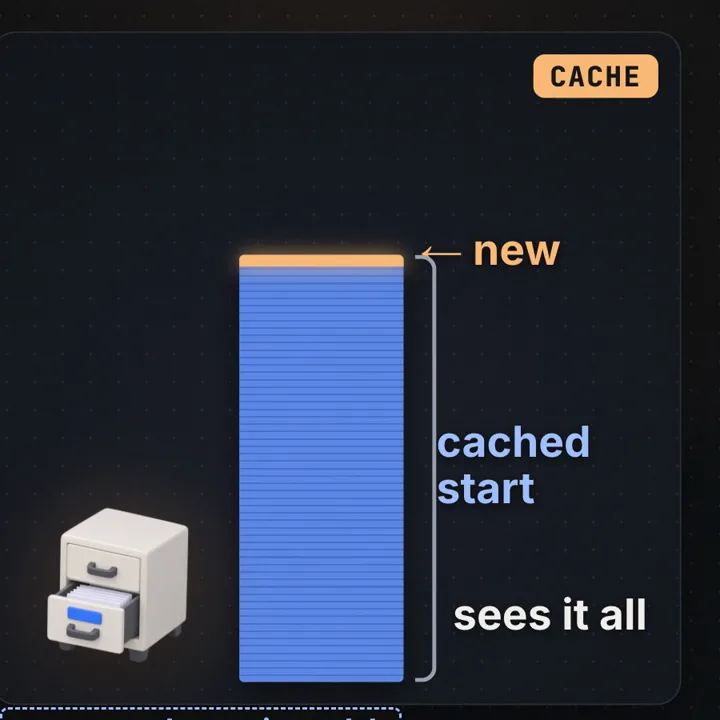
How it works, from the official docs:
- Exact prefix match. A hit needs the request to begin with exactly the same tokens as a cached entry. In the Claude docs the prefix is built in the order tools, system, messages, and a change at one level invalidates that level and everything after it. The OpenAI docs make the same point: put a breakpoint after the static content, so content that changes comes after the reusable prefix.
- Breakpoints, Claude.
cache_controlmarks cache points, up to 4 per request, with a backward lookback of up to 20 blocks from each breakpoint. - Claude limits and prices. Minimum cacheable prefix from 512 to 4,096 tokens depending on the model. Default entry lives 5 minutes, refreshed on each use, with a 1-hour option. A cache read is 0.1x the base input price on many models (lower on some), a 5-minute write 1.25x and a 1-hour write 2x. Usage reports
cache_creation_input_tokensandcache_read_input_tokens.
OpenAI's guide separates model generations, so the rules below are not interchangeable:
- GPT-5.6 and later. Implicit caching by default, or explicit mode with
prompt_cache_breakpointon content blocks (up to four cache writes per request). Minimum cacheable prompt 1,024 tokens. Default minimum lifetime 30 minutes; in the Responses API a 12-hour lifetime can be requested at a higher write rate. Writes cost 1.25x the uncached input rate for 30 minutes and 2.5x for 12 hours; reads 0.1x on most models. Each input token is billed at exactly one of the uncached, cached or write rates. Cached tokens are reported at the exact eligible boundary; usage hascached_tokens(reads only) andcache_write_tokens.prompt_cache_keyis optional and used for separate cache accounting. - GPT-5.5 and earlier. No separate cache-write charge. Retention is set with
prompt_cache_retention: in-memory entries typically last 5 to 10 minutes of inactivity, up to one hour, and the 24-hour option on listed models typically lasts around 30 minutes and up to 24 hours. Cached tokens are reported rounded down to a multiple of 128. A stableprompt_cache_keyhelps route requests that share a prefix to the same cache.
Check the current page for the model you use; these details change between generations.
An agent is close to the ideal workload: every request is the previous request plus a small tail. The lab prices it with write-premium caching (the Claude style, and OpenAI from GPT-5.6), assuming every re-sent token is a cache read at 10% of input and every new token is written once at 125%; minimum size and expiry are ignored:
medium, 30 calls, illustrative USD per 1M: read 0.30, write 3.75, output 15
re-sent  = 863,762 - 51,686 = 812,076 × 0.30 / 1M = $0.2436
new      =           51,686 ×  3.75 / 1M        = $0.1938
output                                           = $0.0358
cached total ≈ $0.4733 (lab)    plain total = $2.6271 (lab)
saving = 1 - 0.4733 / 2.6271 = 82.0%
The token count stays at 863,762, with 94.0% re-sent and growth close to N squared. Caching lowers the price of the history term but leaves its shape and the context window as they were: request 50 (medium) is 95,962 tokens, cached or not. At these prices a write costs 0.25x extra and one read saves 0.9x, so a prefix pays off once it is read again. Under caching the history term still costs prefill on each new tail against the full context, and KV memory still scales with request size. What disappears is the repeated prefill of the prefix.
Worked example
The video pictures one task as a paper stack beside a photocopier: each call copies all earlier pages and adds one thin sheet. The lab's medium profile in numbers:
Inputs (synthetic, chosen by us)
  fixed part F (system + 10 tool schemas + task)  = 2,230 estimated tokens = request 1
  tool mix: read_file, grep, run_tests, edit_file, list_dir; seeded, same every run
  profile medium: keeps 50% of each tool output
  tokens: synthetic JSON-size token estimates over the whole request body
          (keys and escaping included), word-piece rule cross-checked with chars/4;
          no model tokenizer, not billable usage
  prices: illustrative USD 3 / 15 per 1M input / output, cache read 10%, write 125%

30 calls
  request 30            = 51,686   of which new 1,375
  total input           = 863,762
  total new input       = 51,686   (= request 30, telescoping)
  re-sent share         = 1 - 51,686 / 863,762 = 94.0%
  read multiple         = 863,762 / 158 = 5,467x     (chars/4: 3,512x)
  cost multiple         = 277x plain;  cost $2.63 plain, $0.4733 cached (82% less)

growth
  10 calls 98,386 → 50 calls 2,358,122 = 23.97x  (chars/4: 21.31x),  exponent 1.97

profiles at 30 calls (keep 20 / 50 / 100% of tool output)
  cost multiple 136x / 277x / 504x
The read multiple moves from 5,467x to 3,512x under the other estimator, because the two rules count the chat's short prose differently; the growth ratio and re-sent share (94.0% vs 94.2%) barely move. Trust ratios within a run, not a multiple against a tiny baseline.
Code
This script reproduces the growth from the lab's 30 request sizes in a few lines: it sums them, checks the telescoping identity, fits the F + a model, prints the re-sent share against 1 - 2/N, prices the cache, and computes the concept-only cap. Node 22, no packages.
// history_growth.mjs: why an agent's total input grows close to N squared.
// Node 22, no packages. Numbers are the lab's medium profile (labs/ai-7/output.txt):
// estimated tokens from a synthetic simulation, not a billed run.

// Full size of requests 1..30 (request 1 = fixed part F: system + 10 tool schemas + task).
const R = [2230, 3123, 6190, 7193, 8087, 9039, 13981, 14310, 16486, 17747,
  18894, 19304, 23888, 24207, 28556, 30372, 33449, 33997, 37946, 39949,
  40455, 44603, 45108, 45655, 48336, 49070, 49633, 49957, 50311, 51686];

const sum = (xs) => xs.reduce((a, b) => a + b, 0);
const fmt = (n) => Math.round(n).toLocaleString('en-US');

// 1. Measured: total input is the sum of every request; new tokens telescope to R[N-1].
const N = R.length;
const total = sum(R);
const fresh = R.map((r, k) => (k === 0 ? r : r - R[k - 1]));
console.log('total input      ', fmt(total));                        // 863,762
console.log('new tokens       ', fmt(sum(fresh)), '= last request', fmt(R[N - 1]));
console.log('re-sent share    ', ((1 - R[N - 1] / total) * 100).toFixed(1) + '%');

// 2. Constant-increment approximation: fixed part F plus the same increment a per call.
//    R_k = F + (k - 1) a,  T(N) = N F + a N (N - 1) / 2
//    a is derived from the two endpoints (first and last request), an approximation,
//    not a fit: real increments are lumpy and the exact total is the weighted sum
//    N F + sum_j a_j (N - j), which is what `total` above measures.
const F = R[0];
const a = (R[N - 1] - F) / (N - 1);
const T = (n) => n * F + (a * n * (n - 1)) / 2;
console.log('avg increment a  ', fmt(a));
console.log('model T(30)      ', fmt(T(30)), 'vs measured', fmt(total));
for (const n of [5, 10, 20, 30, 50, 100]) {
  const share = 1 - (F + (n - 1) * a) / T(n);
  console.log(`  N=${String(n).padStart(3)}  T=${fmt(T(n)).padStart(10)}  re-sent ${(share * 100).toFixed(1)}%  (1 - 2/N = ${((1 - 2 / n) * 100).toFixed(1)}%)`);
}
console.log('model growth 10 to 50', (T(50) / T(10)).toFixed(2) + 'x', ' exponent', (Math.log(T(50) / T(10)) / Math.log(5)).toFixed(2));

// 3. Illustrative prices, USD per 1M tokens (assumed, not a quote): input 3, cache read 10%, write 125%.
const P = { input: 3, read: 0.3, write: 3.75 };
const plain = (total * P.input) / 1e6;
const cached = ((total - R[N - 1]) * P.read + R[N - 1] * P.write) / 1e6; // every new token written once, every old token read
console.log('input cost plain ', '$' + plain.toFixed(4), ' cached', '$' + cached.toFixed(4));

// 4. Concept only (the lab does NOT simulate this): cap every request at the size of request 10.
const cap = R[9];
const capped = sum(R.map((r) => Math.min(r, cap)));
console.log('capped at', fmt(cap), '->', fmt(capped), 'total input (ignores summary cost and cache misses)');
node history_growth.mjs
node labs/ai-7/run.mjs # the full lab, from the repository rootWhat to observe in history_growth.mjs:
- Telescoping. New tokens sum to 51,686, exactly the last request, so the re-sent share is 94.0%.
- The approximation is close, not exact. With the endpoint-derived a = 1,705 the model gives 808,740 for 30 calls against the measured 863,762, 6.4% low, because real increments are lumpy and some large tool results land early. The modelled re-sent share follows 1 - 2/N closely from 20 calls up (90.6% vs 90.0% at 20, 98.0% at 100).
- The model's own exponent between 10 and 50 calls is 1.93 (22.22x); the lab measured 1.97 (23.97x). Both sit just under 2 because of the linear F term.
- Caching takes the input cost from $2.5913 to $0.4374. Add the $0.0358 of output and you get the lab's $2.6271 and roughly $0.4733.
- The cap gives 453,326 tokens. It is a concept, not a lab result.
What to observe in node labs/ai-7/run.mjs: it runs in a few seconds with no network and no API key, prints the three profile tables for N = 5, 10, 20, 30 and 50, all 50 per-request sizes for the medium profile, the chars/4 cross-check and a final RESULT JSON line. Same seeds, same numbers every run. Check that the "new input" column always equals the "last request" column: that is the telescoping identity again.
Failure modes and edge cases
Hitting the context window. Request size grows linearly, so a long task eventually exceeds the model's context window and the call fails. Detect it by logging request size per call and alerting at a fraction of the limit; fix it with tool output caps, sub-tasks that start with a fresh context, or compaction. The Claude context windows page also warns that accuracy and recall degrade as token count grows, so a request that fits is not automatically a good one.
Silent cache misses. A timestamp in the system prompt, tool definitions serialized in a different key order, a tool added mid-task or an edit to an early message changes the prefix. Cached prefixes that include the change can no longer be reused; an eligible unchanged prefix before it can still hit, and everything after it incurs the applicable uncached or cache-write rate. A change in the system prompt or tools is the worst case, because almost nothing precedes it. Detect it from the usage fields, reads and writes both: Claude reports cache_read_input_tokens and cache_creation_input_tokens; OpenAI reports cached_tokens and, on models with write pricing, cache_write_tokens. In a healthy append-only loop, reads rise with the call index and writes stay near the size of each new tail. Writes close to the whole request size on consecutive calls mean the prefix is unstable.
Cache expiry during slow steps. A tool that outlasts the TTL (a long test suite, a human approval) leaves no reusable prefix, so the next request bills the whole history at the uncached or cache-write rate, depending on provider and model. Use a longer TTL where offered, and price the longer TTL's higher write rate against how often your steps actually exceed the short one.
One huge early tool result. An unfiltered log on call 2 is re-sent on every later call. Rank tool results by size times remaining calls; fix it at the tool.
Budget checks per call instead of per task. Each call looks reasonable; the task does not. Check the running total against a per-task budget on every call.
Reasoning tokens. The lab does not simulate them. Where an API expects reasoning items passed back, they join the history and the bill.
Trade-offs
| Option | Good for | Costs you | Use when |
|---|---|---|---|
| Do nothing, full history every call | The model sees every detail; simplest loop; prefix stays cache friendly | Input close to N squared; 94.0% re-sent at 30 calls in the lab | Short tasks, a handful of calls |
| Smaller tool results at entry | Lowers the slope a; in the lab 504x to 136x one chat's cost at 30 calls (keep 100% to 20%) | The model may miss a line it needed and call the tool again | Always, as the first fix; caps, line ranges, failure-only test output |
| Prompt caching | Same tokens billed at a read price; 82% lower illustrative cost in the lab | Write premium, TTL, minimum size; needs a byte-stable prefix | Any agent loop; put static content first |
| Clearing old tool results | Caps request size, growth closer to linear (concept) | Prefixes that include the edit stop hitting; the part after it is billed uncached or as a write ($0.0345 per 10,000 tokens rewritten at the lab's prices); detail is gone | Long tasks near the context limit; clear in large batches when break-even calls (6 in the example above) are well under the remaining calls |
| Summarizing or compacting history | Keeps decisions while dropping raw output (concept) | Extra model call to summarize; summary can lose facts; cache reuse stops at the first edited block | Very long sessions where old raw output no longer matters |
| Sub-tasks with a fresh context | Each sub-task restarts the staircase at F | Hand-off design; results must be passed back explicitly | Separable work such as "find the bug" then "write the test" |
Common mistakes
usage after it.In an interview
- Clarify: how many calls does a typical task take, how big are tool outputs, and is the concern cost, latency or the context limit?
- Assumptions: state F, the average increment a and N; say prices are assumed.
- Structure: client agent loop, model with no memory between invocations, tools, the retained message list (client-side or server-stored) as the only state, usage logging.
- Deep dive: request k = F + history; T(N) = N·F + a·N(N-1)/2; new tokens telescope to RN; re-sent share near 1 - 2/N.
- Trade-offs: tool output caps vs missed detail, caching vs prefix stability, compaction vs cache misses and lost facts.
- Wrap up: metrics per task (total input, cached share, largest tool result, peak request size) and a per-task budget.
The model keeps nothing between invocations, so in an append-only loop every call's context is the system prompt, tool schemas and every earlier message and tool result, whether I upload it or the provider rebuilds it from stored state. Request sizes form a staircase, and with roughly constant increments the total is N times the fixed part plus about a times N(N-1)/2: close to N squared. That is logical input; upload bytes, prefill compute and KV memory each need their own accounting. Most of it is old tool output sent again; in one synthetic simulation, 94% at 30 calls. I'd apply three fixes. First, shrink each tool result before it enters history: line ranges, match caps, failure-only test output. Early results matter most because they are re-sent most. Second, keep the prefix byte-stable and use prompt caching, which bills re-sent tokens at a cache-read price without changing the count. Third, for long tasks, clear or summarize old tool results or split into sub-tasks, once the per-call saving times the remaining calls beats the cost of rewriting the cached tail after the edit. I track total input, cached share and peak request size against a per-task budget.
Practice
BeginnerWhy does request 30 contain the tool result from call 3?
The model keeps no memory between invocations, and the loop is append-only. The only way the model can use that result on call 30 is for it to be in call 30's context, uploaded again by the client or rebuilt from server-stored conversation state, and billed as input either way.
IntermediateWrite total input for N calls with fixed part F and average increment a.
Under the constant-increment approximation, T(N) = N·F + a·N(N-1)/2: request k is F + (k-1)·a, and summing k = 1 to N gives an arithmetic series. The exact total for lumpy increments is N·F + sum of aj·(N - j). The quadratic term dominates long tasks.
IntermediateWhy does the total of new tokens across a task equal the size of the last request?
New tokens in request k are Rk - Rk-1. Summing from 1 to N telescopes to RN. In the lab: 51,686 at 30 calls, so 1 - 51,686 / 863,762 = 94.0% is re-sent.
IntermediateThe lab's read multiple is 5,467x but the cost multiple is 277x. Why?
The chat's cost is 95.0% output (601 tokens at 15 per 1M); the agent's is 98.6% input (at 3 per 1M). Input over input compares the part where the chat is smallest; cost over cost weights each by price.
AdvancedKeeping 20% instead of 100% of tool output cut total input to 26.4% of heavy, not 20%, and the re-sent share stayed near 94%. Explain both.
Trimming lowers only the tool-result part of a; the fixed part F and the model's messages are untouched, so the total shrinks by less than the keep fraction. The re-sent share is 1 - [F + (N-1)·a] / T(N); it approaches 1 - 2/N when the history term dominates, which it does at 30 calls in all three profiles. Scaling a alone can still move S because F is unchanged; here the shift is 0.2 points.
AdvancedYour agent's cached token count stays near zero on every call. What do you check?
Anything that changes the prefix: timestamps or IDs in the system prompt, tool definitions in a different order, edits to early messages, history clearing, a prefix under the minimum cacheable size, or gaps longer than the TTL. Compare the serialized prefix bytes of two consecutive requests, and watch cache-write tokens: writes near the full request size on every call confirm the prefix changes each time.
AdvancedWhy can clearing old tool results raise cost on the next call even though it sends fewer tokens?
An edit prevents reuse of cached prefixes that include it. The unchanged prefix before the edit can still hit, but everything after it incurs the uncached or cache-write rate instead of a cheap read. At the lab's prices, rewriting 10,000 cached tokens costs (3.75 - 0.30) × 10,000 / 1M = $0.0345, and clearing 20,000 tokens saves $0.006 per later call, so it pays off from the 6th later call (more once summary cost is included).
Cheat sheet
| Term or formula | Meaning |
|---|---|
| No memory between invocations | The model computes only over the current context; retained history is input again, uploaded or rebuilt from stored state |
| Prefill vs decode | Prefill builds per-layer K/V tensors for all uncached input (attention part grows with L²); decode reads the KV cache per output token (linear in L) |
| Rk = F + a1 + ... + ak-1 | Request k is the fixed part plus all earlier increments |
| T(N) = N·F + a·N(N-1)/2 | Total input, an arithmetic series, close to N squared for long tasks |
| Sum of new tokens = RN | Telescoping: everything else in the total was re-sent |
| Re-sent share ≈ 1 - 2/N | When the history term dominates F; 93.3% at 30 by formula, 94.0% measured in the lab |
| p = log(T(50)/T(10)) / log 5 | Growth exponent; 1.97 in the lab (23.97x for 5x calls) |
| Read, combined, cost multiple | 5,467x, 1,141x, 277x at 30 calls in the lab; never mix them |
| Trim at entry | Lowers slope a, keeps shape and cache; 136x, 277x, 504x cost at 20, 50, 100% kept |
| Compaction, context editing | Removes saved history, caps size; cache reuse stops at the first edit; pays off when k·(C - s)·read exceeds R·(write - read) + s·write + summary cost |
| Prompt caching | Exact prefix reuse, breakpoints, minimum size, TTL; cheaper reads, same tokens; 82% lower illustrative cost |
Further reading
- Claude API docs, Prompt caching: prefix order, breakpoints, minimum sizes, TTL, prices, invalidation.
- OpenAI API docs, Prompt caching: KV tensors, implicit and explicit breakpoints, per-generation lifetime and reporting,
cached_tokensandcache_write_tokens. - vLLM docs, Automatic prefix caching: block hashing chained over the prefix and LRU eviction, an open implementation of the same idea.
- OpenAI API docs, Conversation state: passing history yourself vs stored, chained responses; earlier input still billed.
- Claude API docs, Context windows: how the window fills, and why more context is not automatically better.
- Claude API docs, Context editing: clearing old tool results, and the effect on cached prefixes.
- Claude API docs, Token counting: real tokenizer counts instead of estimates like ours.
Earlier in the series: why text appears before the reply is complete in streaming AI replies (AI 2), and how retrieval keeps prompts small by sending only the chunks that matter in RAG retrieval (AI 4). Tool results are also untrusted input that stays in history, as the prompt injection article (AI 6) shows.
This article describes general patterns for agent loops, illustrated with our own synthetic simulation in labs/ai-7. Token counts are estimates from a word-piece rule cross-checked with characters divided by 4, not a model tokenizer; prices are illustrative and nothing was billed. The numbers show the shape of the effect, not any company's product, prices or private systems.
Frequently asked questions
Why does an AI agent send its history again on every call?
The model keeps no memory between invocations; each one computes over its whole context. In an append-only agent loop that context is the system prompt, tool definitions and every retained message and tool result. The client can upload it, or the service can rebuild it from stored conversation state; official docs state the earlier input tokens are still billed as input either way.
Why do AI agent tokens grow close to N squared?
If history is retained, request k contains the fixed part plus everything added in calls 1 to k-1, so request sizes form a rising staircase. With roughly constant increments a, summing N steps gives N times the fixed part plus about a times N(N-1)/2. The second term dominates long tasks. In our lab, 5x more calls (10 to 50) meant 23.97x more input.
Does prompt caching reduce the number of tokens?
No. The full context is still the model input. Caching reuses the stored key/value tensors of an unchanged prefix, so those tokens are billed at a lower cache-read price and processed faster. In our lab at illustrative prices it cut the 30-call cost by 82% with the same 863,762 input tokens.
Is trimming tool output the same as compaction?
No. Trimming at entry makes each new tool result smaller before it joins the history, which lowers the slope of the curve but keeps it close to N squared. Compaction or context editing removes or summarizes history that is already saved, which can cap request size and make growth closer to linear, but cached prefixes that include the edit can no longer be reused. Our lab simulates only the first.
So does one agent task cost as much as 1,000 chats?
It depends on which measure you mean. In our synthetic lab a 30-call medium task reads 5,467x one chat's input tokens but costs 277x one chat at illustrative prices. Only the heavy profile at 50 calls passed 1,000x in cost (1,411x). Real numbers depend on the model, prompts, tools and caching.
Are these numbers from a real AI product?
No. They come from labs/ai-7, a synthetic simulation on one Mac with estimated tokens (a word-piece rule cross-checked with characters divided by 4) and illustrative prices. Nothing was billed and no model was called. The lab shows the shape of the effect, not any product's real numbers.
Sources
- Claude API docs: Prompt cachingplatform.claude.com
- OpenAI API docs: Prompt cachingdevelopers.openai.com
- OpenAI API docs: Conversation statedevelopers.openai.com
- Claude API docs: Context windowsplatform.claude.com
- Claude API docs: Context editingplatform.claude.com
- Claude API docs: Token countingplatform.claude.com
- vLLM docs: Automatic prefix cachingdocs.vllm.ai

Written by a software engineer and system architect with 10+ years of building production web, payment, ticketing and accounting systems in Japan and Nepal. About us